
Vacation Rental Photography Tips That Boost Bookings
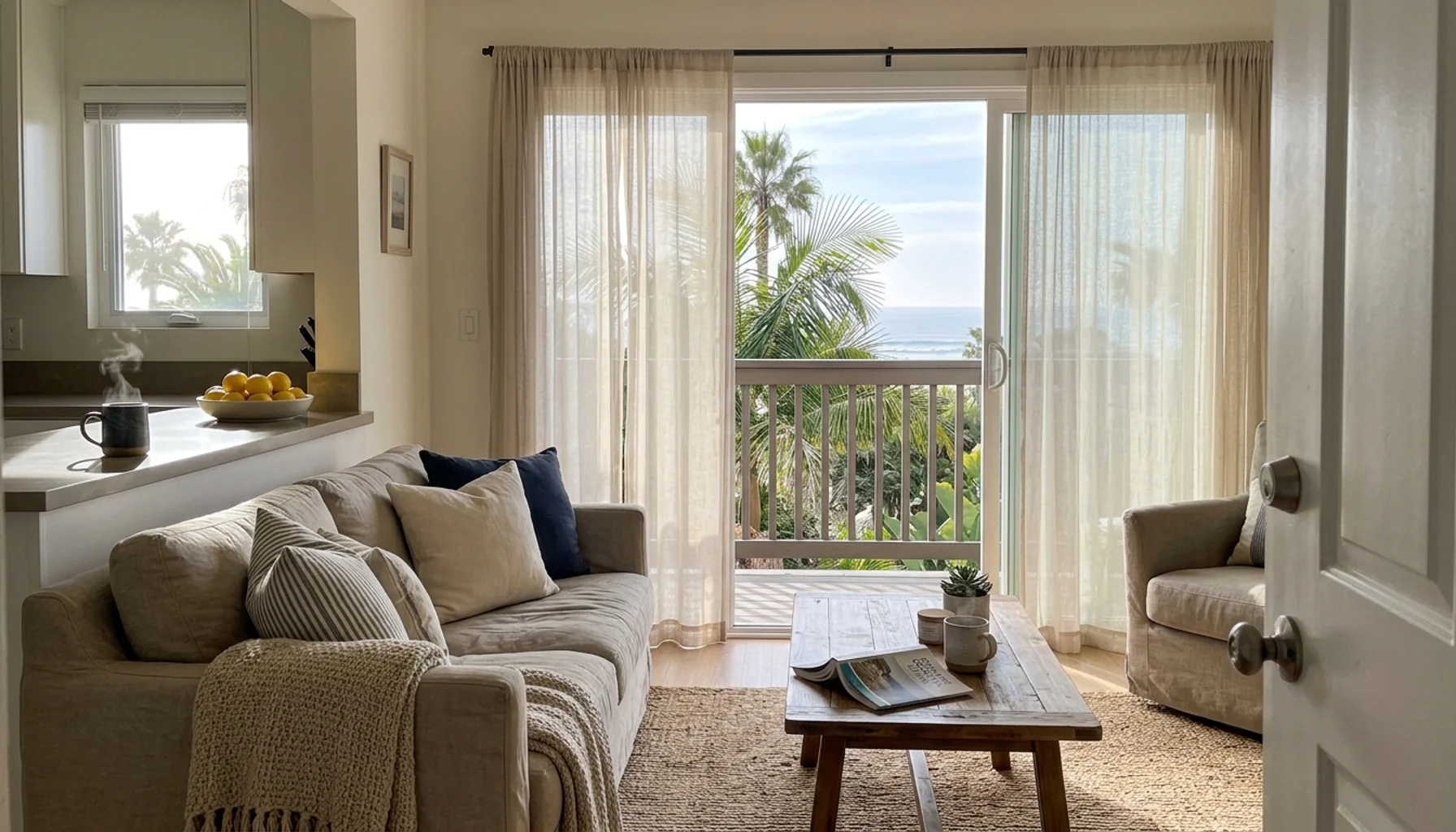
A candid morning shot of an Oceanside rental — natural light, tidy styling, zero staging stiffness.
Vacation rental photography tips that move the needle on bookings have almost nothing to do with expensive gear and everything to do with light, staging, and shot sequencing. At West Coast Homestays, we've audited enough underperforming listings across Oceanside, Encinitas, and Carlsbad to know that photography is usually the first thing owners get wrong, and the first thing that's cheap to fix. Most of what hosts believe about listing photos is myth, and those myths are costing bookings every week they go uncorrected.
Key Takeaways
Dynamic pricing tools work best on listings with strong photography; research from PriceLabs and Your.Rentals found dynamic pricing alone drove a 36.3% increase in gross revenue per unit across 541 Airbnb listings in 34 countries, but that lift depends on a listing converting clicks into bookings first.
Natural daylight, not professional flash equipment, is the biggest factor separating listings that convert from ones that sit unbooked.
Airbnb and VRBO listings typically need 20 to 35 photos to fully represent a property, not the 8 to 10 many first-time hosts upload.
Staging for photography matters more than the photographer's equipment tier.
Professional vacation rental photography in coastal San Diego markets typically costs less than one weekend's booking revenue, an expense most owners recoup within the first month of improved bookings.
Golden hour (the hour after sunrise and before sunset) is the best time to shoot exteriors and ocean-adjacent properties, especially in Pacific Beach, La Jolla, and Mission Beach.
Photography is the first filter guests apply when scrolling Airbnb or VRBO search results in 2026, and the decision happens in under a second. A guest decides whether to tap into a listing based almost entirely on the cover photo and the first three images in the gallery. If those photos are dark or cluttered, the listing gets scrolled past regardless of how good the actual property is.
This article breaks down the myths hosts believe about vacation rental photography and replaces each one with what we've observed managing properties across San Diego's coastal neighborhoods. Readers will get practical guidance on timing, staging, and shot count, plus a quick-facts table to reference before the next shoot.
Static, dated photos are one of the most common reasons a new listing sits with zero bookings for its first several weeks on the market. Fixing photography is usually the fastest, cheapest lever an owner can pull before touching price or amenities.
Myth: A Smartphone Can Never Compete With Professional Photography
A smartphone can produce a usable cover photo for exterior and daylight shots, but the claim that smartphones can never compete with professional photography is false in some cases and true in others. Where smartphones consistently fail is interior wide shots of small rooms, since a modern smartphone camera lacks the lens correction professional equipment provides. In good natural light with a steady hand or tripod, smartphone results can still hold up for a primary cover image.
Professional real estate and vacation rental photographers use wide-angle lenses (typically 16mm to 24mm equivalent) that make rooms look proportionate rather than distorted. A smartphone's standard lens tends to either crop out too much of a room or introduce a fisheye warp near the edges. For a studio or one-bedroom coastal cottage in Mission Beach, that distortion is the difference between a room looking cozy and a room looking cramped.
We recommend a hybrid approach: use a smartphone for quick seasonal refreshes, but invest in a professional shoot for the primary listing gallery. Professional vacation rental photography is a baseline service that Oceanside Airbnb management teams handle, not an upsell.
Myth: More Furniture and Decor in the Shot Makes a Property Look More Luxurious
More furniture and decor in a photo does not read as luxurious; in nearly every case, cluttered staging photographs worse than minimal staging. A room with extra throw pillows, stacked books, and decorative objects on every surface reads as busy and small in a photograph, even if the same room feels comfortable in person. Photography compresses depth, so visual clutter that the eye filters out in real life becomes the dominant element in a static image.
The staging principle that works best for vacation rentals is subtraction, not addition. For example, clearing kitchen counters down to two or three intentional objects, removing personal items and visible trash cans, and making beds with a maximum of one accent pillow per two standard pillows all reduce visual noise.
A beautifully staged coastal living room with natural light and ocean-toned decor photographs well because the surfaces are clear and the color palette is limited to two or three tones. As a result, West Coast Homestays' interior design and staging service exists because staging for photography is a distinct skill from staging for daily living, and the two goals sometimes conflict.
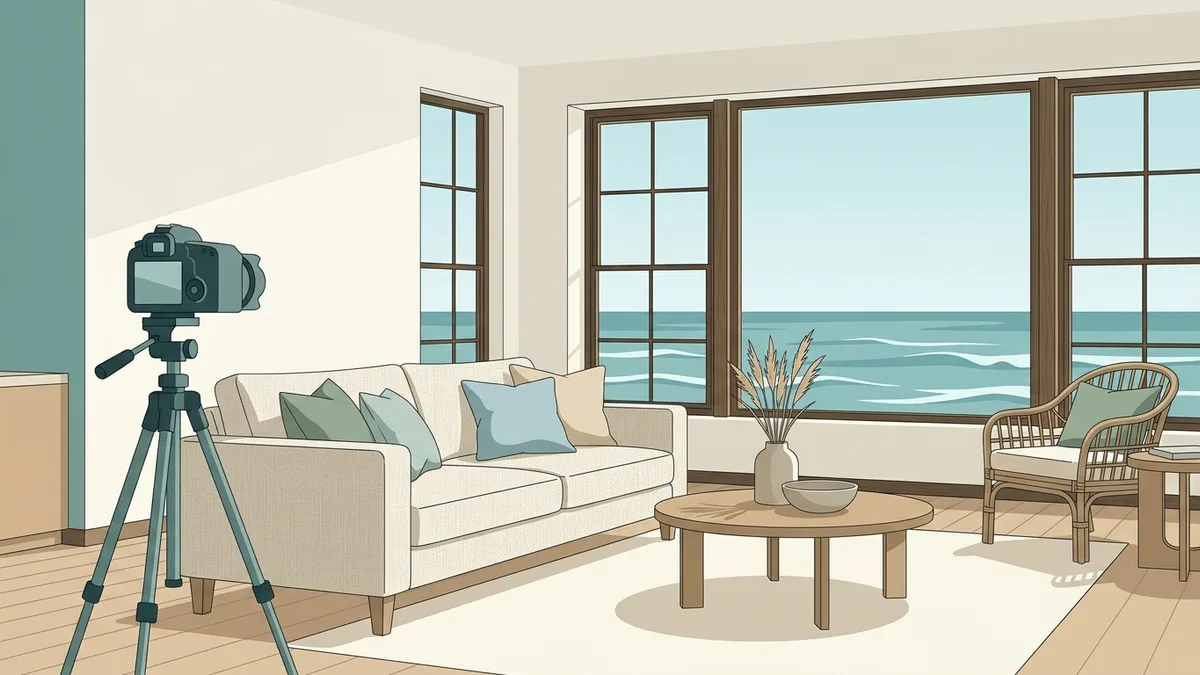
A beautifully staged coastal living room with natural light streaming through large windows and ocean-toned decor
What Is the Best Time to Photograph a Vacation Rental?
The best time to photograph a vacation rental is during golden hour, roughly the hour after sunrise or the hour before sunset, when light is soft and directional rather than harsh and overhead. Interior shots should be scheduled for mid-morning to early afternoon on a clear day, when indirect daylight fills rooms without creating blown-out window glare. Exterior timing depends heavily on which direction the property faces.
Exteriors facing west, common along the Pacific Beach and Mission Beach boardwalks, photograph best in late afternoon when the sun is behind the camera rather than behind the property. In contrast, properties with an east-facing patio or ocean view, more typical in parts of La Jolla, benefit from early morning shoots instead.
Avoid shooting on overcast days if the property's main selling point is a coastal view or outdoor space, since flat gray skies drain color from ocean and sky shots. If a shoot must happen on a cloudy day, prioritize interior rooms and save exterior and view shots for a clearer window later that week.
How Do You Stage a Vacation Rental for Photos?
Staging a vacation rental for photos means preparing every room to look intentional and true to what a guest will actually experience upon arrival. The process starts the night before a shoot, not the morning of, since it includes tasks like ironing linens and testing every light fixture before the photographer arrives.
Follow this sequence before any shoot:
Deep clean every surface, including baseboards and window tracks, since photography catches dust that the naked eye skips over.
Turn on every lamp and overhead light in the property, even during a daytime shoot, to eliminate shadowed corners.
Remove all personal items: mail, medications, chargers, pet bowls, and family photos.
Set two to three place settings at the dining table and stage the kitchen counter with two or three curated objects, such as a bowl of fruit or a coffee setup.
Open all curtains and blinds fully to maximize natural light, then check for reflections in mirrors or glass that could show the photographer.
Style each bed with fresh, tightly tucked linens and no more than two accent pillows.
Stage the exterior last, sweeping patios, coiling hoses, and positioning outdoor furniture symmetrically.
A guest-ready checklist like the one many Airbnb hosts reference for turnover prep covers similar ground for daily operations, but photography staging is more exacting since the camera magnifies every imperfection a guest's eye would otherwise skip.
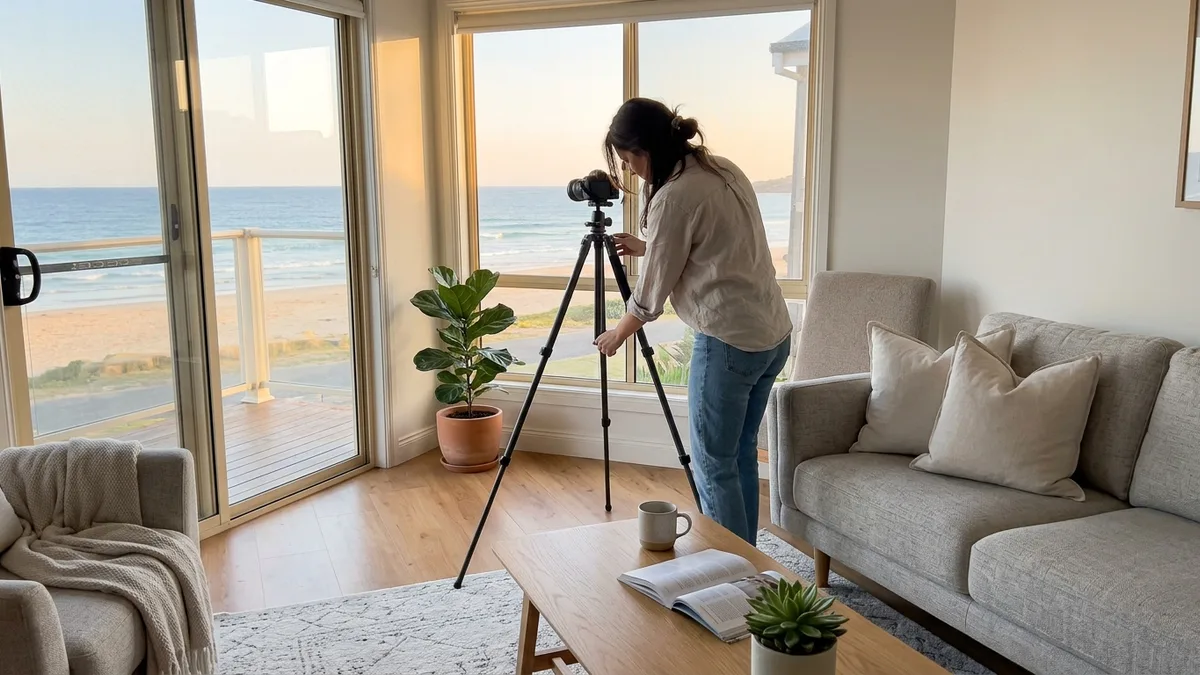
A photographer setting up a tripod in a bright coastal living room during golden hour
How Many Photos Should a Vacation Rental Listing Have?
A vacation rental listing should include between 20 and 35 photos to fully represent the property and set accurate guest expectations. Listings with fewer than 15 photos consistently underperform because guests interpret a thin gallery as a sign the host is hiding a small room, dated finishes, or a lack of natural light.
The ideal gallery structure looks like this: one strong exterior or hero shot as the cover image, followed by two to three angles of the living room, two to three of the kitchen, two per bedroom, two per bathroom, one or two of any outdoor space, and a handful of neighborhood or lifestyle context shots.
A two-bedroom, two-bathroom coastal property with a patio typically lands around 24 to 28 photos when staged correctly. Skipping bathrooms or laundry areas is a common mistake, since guests actively search for those images before booking. As a result, their absence reads as a red flag rather than a neutral omission.
How Much Does Vacation Rental Photography Cost?
Professional vacation rental photography in San Diego County is priced by property size, whether twilight or drone shots are included, and how many rooms need staging beforehand, so the cost swings widely between a small condo and a large view property. Larger properties with multiple bedrooms, an ocean view, or outdoor amenities sit at the higher end because the shoot takes longer and requires more images to cover.
Most photographers price by square footage or room count rather than a flat fee. For example, a one-bedroom Encinitas condo costs meaningfully less to shoot than a five-bedroom La Jolla estate with a pool and ocean view. Drone photography, useful for coastal properties near Carlsbad or Oceanside where the view itself is a selling point, is typically an add-on rather than included in a base package.
Owners tend to recoup this cost quickly. A listing that converts an extra one or two bookings a month because of stronger photography pays for the shoot many times over across a year, especially when paired with dynamic pricing that's already calibrated to capture that added demand. This is exactly the kind of listing optimization La Jolla Airbnb management teams build into onboarding for new owners, since photography and pricing strategy perform best when addressed together rather than sequentially.
Myth: Wide-Angle Lenses Make Every Room Look Bigger and Better
Wide-angle lenses do not automatically make every room look bigger and better; overcorrected wide-angle shots can instead make small rooms look distorted and untrustworthy. Guests have become visually literate about listing photography, so an ultra-wide shot that bends door frames or makes a queen bed look oversized relative to the room triggers skepticism. That skepticism often shows up in guest complaints about a room being "smaller than the photos."
The sweet spot for interior real estate photography sits between 16mm and 24mm equivalent focal length. Anything wider starts introducing visible barrel distortion at the edges of the frame, where straight lines begin to curve unnaturally.
We've seen listings where an overcorrected bathroom shot made a small three-piece bathroom look nearly double its actual size, and the resulting guest reviews consistently flagged the mismatch. Accuracy protects a host's rating more than exaggeration protects click-through rate. A five-star review is worth more than one extra click, since building a strong Airbnb brand depends on guest trust holding up after arrival, not just at the search results page.
Myth: Photos Only Matter Once, at Listing Launch
Photos do not only matter once at listing launch; vacation rental photos need refreshing at least once a year, and sooner if the property undergoes any furniture change, renovation, or seasonal update. A listing that launched in 2023 with photography that's never been touched since shows guests an outdated version of the property in 2026. Importantly, Airbnb's and VRBO's search algorithms both weight image freshness and guest-uploaded photo comparisons as trust signals.
Guests increasingly upload their own photos after a stay, and search platforms surface those alongside host photos. For example, if a host's professional images show a living room with a gray sectional but recent guest uploads show a blue one, that mismatch damages trust before a booking even happens.
Seasonal refresh shots, like string lights for winter or updated outdoor furniture for summer, can extend a listing's competitive edge without a full re-shoot. A quick smartphone update between full professional shoots keeps the gallery current at low cost.
Data and Evidence: What Photography Quality Actually Changes
Photography quality directly affects click-through rate from search results, conversion rate once a guest opens the listing, and the effectiveness of dynamic pricing tools layered on top. According to research published by PriceLabs and Your.Rentals in 2026, properties using dynamic pricing across 541 Airbnb listings in 34 countries saw a 36.3% increase in gross revenue per unit and a 37.3% increase in nights booked per unit. AvantStay's 2026 data similarly puts the dynamic pricing revenue lift between 10% and 40% annually.
None of that pricing lift materializes if a listing's photography can't convert impressions into clicks in the first place. Here's how photography quality tiers compare based on what we see across our own managed portfolio and general industry practice, not a named external benchmark:
- Typical Shot Count
- Smartphone, no staging: 8-12
- Smartphone, staged: 15-20
- Professional shoot, standard package: 20-30
- Professional shoot with drone and twilight add-ons: 30-35+
- Smartphone, no staging: Emergency listing refresh, mid-term rental filler shots
- Smartphone, staged: Seasonal updates between professional shoots
- Professional shoot, standard package: Primary listing launch and annual refresh
- Professional shoot with drone and twilight add-ons: Ocean-view or amenity-heavy properties competing at the top of search
- Smartphone, no staging: Inconsistent lighting, no wide-angle correction, cluttered frames
- Smartphone, staged: Limited depth in small rooms, no twilight or drone options
- Professional shoot, standard package: Cost is a barrier for first-time hosts without a management partner
- Professional shoot with drone and twilight add-ons: Highest cost tier, only worth it for view-driven or luxury properties
In our experience across San Diego's coastal neighborhoods, the jump from "smartphone, no staging" to "professional shoot, standard package" produces the largest single improvement in click-through rate of any tier upgrade. The jump from standard professional to drone-and-twilight matters mainly for properties where the view or exterior amenities are the primary selling point, such as ocean-facing units in Pacific Beach or Del Mar-adjacent listings.
Practical Guidance: How to Choose Your Photography Approach
Choosing the right photography approach depends on property type, budget, and how competitive the surrounding compset is. A studio in a less saturated pocket of North County San Diego doesn't need the same investment as a five-bedroom oceanfront home competing against dozens of similar listings in Pacific Beach or La Jolla.
Use this decision framework:
New listing launch: Always invest in a professional standard package. First impressions on Airbnb and VRBO search results are set within the first 90 days, and thin or amateur photography during that window is difficult to recover from later.
Ocean-view or amenity-heavy property: Add drone and twilight shots. A twilight exterior shot consistently outperforms a daytime one as a cover image for view-driven listings.
Established listing with strong reviews: A smartphone refresh every few months, plus a full professional re-shoot annually, is usually sufficient to keep the gallery current without overspending.
Multi-property portfolio: Standardize a photography schedule and staging checklist across every unit, since inconsistent quality across a portfolio makes weaker properties look worse by comparison.
Common mistakes we see repeatedly: shooting during midday when the sun is directly overhead and creates flat, shadowless light, and forgetting to stage the exterior approach even though it's often the guest's first visual impression. Uploading photos in a random order instead of the sequence a guest would naturally walk through the property is another frequent error.
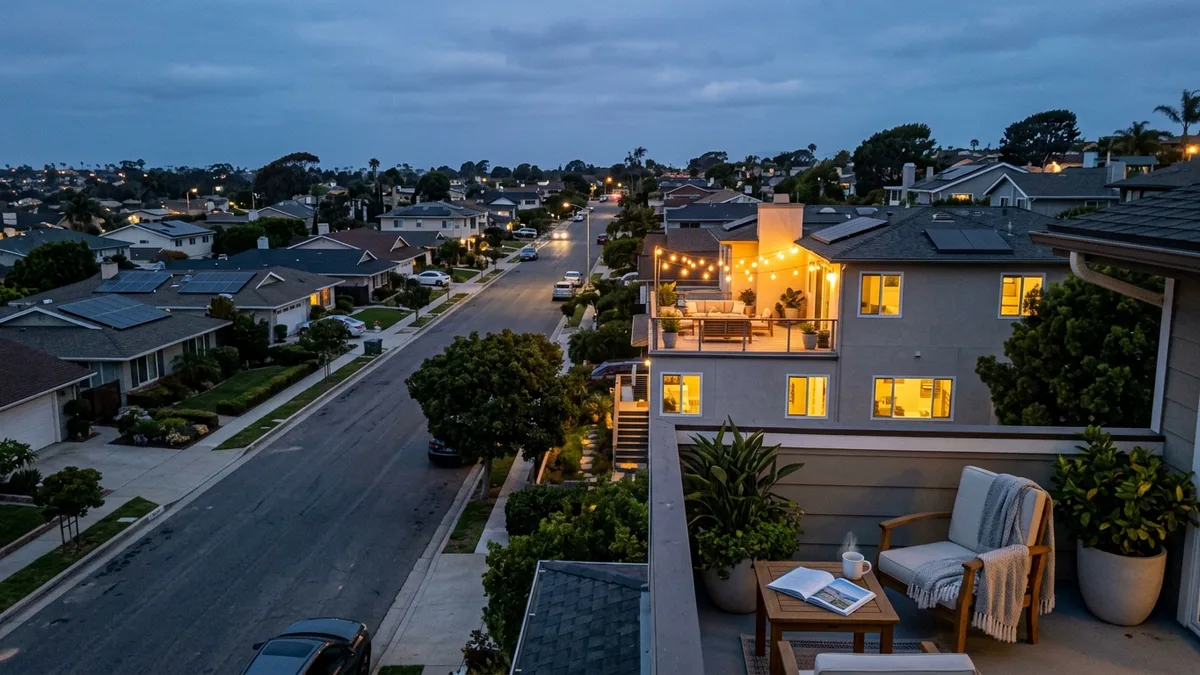
Drone twilight photography for vacation rental listing photos San Diego
Frequently Asked Questions
How do I list my property as a vacation rental in San Diego?
Listing a property as a vacation rental in San Diego requires securing the appropriate short-term rental license through the city before creating an Airbnb or VRBO listing, since operating without one can result in enforcement action. Owners should first check their property's tier and current requirements through the City of San Diego STRO Official Page. Next, confirm the applicable council district using the City of San Diego Council District Map, since district rules can affect the licensing process. Completing both steps before applying helps avoid delays or rejected applications.
How many people can stay in a vacation rental in San Diego?
Occupancy limits for a vacation rental in San Diego depend on the property's licensed configuration, bedroom count, and local fire and safety codes rather than a single citywide number. As a result, two properties with the same bedroom count can carry different occupancy caps depending on their STRO license terms. Hosts should confirm the specific occupancy cap tied to their license and listed bedroom count, since exceeding it can violate both city rules and Airbnb's own guest count policies.
How far in advance should I book a vacation rental in San Diego?
Booking a vacation rental in San Diego at least a few weeks to a couple of months ahead is typical for weekend and shoulder-season stays. In contrast, peak summer weekends and major local events often sell out further in advance, sometimes months earlier. Coastal neighborhoods like La Jolla, Pacific Beach, and Mission Beach tend to book fastest for summer weekends, so earlier booking gives guests more inventory and better rates to choose from.
How much do vacation rental management companies charge?
Vacation rental management fees vary by company, service scope, and property type, so no single flat rate applies across the industry; owners should confirm exact percentages or flat rates directly with the management company rather than relying on general online estimates. Full-service management typically bundles listing optimization, pricing, guest communication, and turnover cleaning into one fee structure. In contrast, co-hosting arrangements often price more narrowly around the specific services provided, such as guest messaging alone or cleaning coordination alone, rather than a full end-to-end package.
How do I know if a vacation rental is legit in San Diego?
A legitimate vacation rental in San Diego should have an active STRO license number displayed or available on request, which travelers can verify through the city's Active STRO Licenses Open Data Portal. Beyond licensing, listings managed by an established local company with verifiable reviews and consistent, professional photography are a stronger trust signal than listings with thin photo galleries or vague property descriptions. A mismatch between a listing's polish and its licensing status is a warning sign worth investigating before booking.
What should I look for when booking a short term rental in San Diego?
When booking a short-term rental in San Diego, look for a full photo gallery of 20 or more images covering every room, recent guest reviews, a clearly stated occupancy limit, and confirmation that the listing operates under a valid city license. A thin photo gallery or photos that look inconsistent with recent guest-uploaded images is a warning sign worth messaging the host about before booking. Together, these four checks give a reliable picture of a listing's legitimacy and quality before a guest commits to payment.
What are the best vacation rental photography tips for Airbnb hosts?
The best vacation rental photography tips for Airbnb hosts are to shoot in natural daylight during golden hour, stage rooms with minimal clutter, and use a wide-angle lens between 16mm and 24mm equivalent to keep room proportions accurate. Hosts should also upload 20 to 35 photos in the order a guest would actually walk through the property, since sequencing affects how the gallery reads. Finally, refresh the gallery annually, or immediately after any furniture or renovation change, to keep the listing competitive as search algorithms increasingly weight image freshness in 2026.
Quick Facts: Vacation Rental Photography at a Glance
The table below summarizes the core recommendations from this article in one place: timing, photo count, lens choice, staging approach, refresh frequency, and cost structure. Together, these six factors form the baseline standard West Coast Homestays applies across its managed properties in Oceanside, Encinitas, Carlsbad, and La Jolla.
- Recommendation
- Best shooting time: Golden hour for exteriors; mid-morning to early afternoon for interiors
- Ideal photo count: 20 to 35 images covering every room and outdoor space
- Lens equivalent: 16mm to 24mm for accurate, undistorted room proportions
- Staging priority: Subtraction over addition; clear surfaces, minimal decor per room
- Refresh frequency: Full professional re-shoot annually, smartphone updates seasonally
- Cost range: Priced per shoot, varying by property size and add-ons like drone or twilight shots
Conclusion
Vacation rental photography tips that work come down to natural light, disciplined staging, correct lens choice, and a full 20 to 35 photo gallery refreshed at least annually. The myths cost owners bookings when left uncorrected: smartphones aren't always adequate, more decor doesn't read as luxury, wide-angle doesn't always help, and photos matter well beyond the initial launch. Getting this right in 2026 matters more than ever, since Airbnb's and VRBO's search algorithms increasingly weight image freshness and guest-uploaded photo comparisons alongside price and reviews.
Strong photography is the foundation everything else builds on. Dynamic pricing, review management, and revenue optimization all perform better once a listing's photos are converting clicks into bookings at a healthy rate.
A beautifully staged coastal living room with natural light streaming through large windows and ocean-toned decor
Photography is one piece of what makes a San Diego listing perform. If you're not sure whether your current photos, pricing, or overall listing strategy are pulling their weight, West Coast Homestays reviews all of it as part of onboarding, from staging and shot lists to dynamic pricing calibration. Our team has driven revenue increases of over $121,000 for owners through combined listing optimization and pricing strategy across our 80-plus managed properties in San Diego's coastal neighborhoods. Reach out to see where your listing's gaps actually are.


