
TOT Tax La Jolla: 2026 Rates and Filing Requirements

A La Jolla rental cottage, where City of San Diego TOT rules apply.
TOT tax La Jolla refers to the City of San Diego's transient occupancy tax, which applies to rentals shorter than one month and is remitted to the Office of the City Treasurer, not San Diego County. At West Coast Homestays, we manage short-term and mid-term rentals across La Jolla and other coastal neighborhoods, and filing with the wrong jurisdiction is one of the first problems we check for. The City lists Tax Zone 1 at 11.75%, so confirm your zone before quoting a rate.
Key Takeaways
La Jolla sits inside the City of San Diego, so City Treasurer rules govern its TOT. The County's separate rate and quarterly dates apply only to unincorporated areas.
City TOT applies to rentals of less than one month and requires a Transient Occupancy Registration Certificate, whether you rent directly, through a manager, or through an online platform.
Returns for periods beginning May 1, 2026 or later use a newer City form, and an older form covers 9/1/2016 through 4/30/2025.
TOT, the Short-Term Residential Occupancy (STRO) license, and the Rental Unit Business Tax are separate obligations. Paying one does not satisfy the others.
La Jolla short-term rentals earn well into the five figures each year, so collected tax is a real budget line that swings with the season.
Owning a rental in La Jolla in 2026 means operating in one of the denser short-term rental markets in the City. The City of San Diego's short-term rental market report counted 1,448 active La Jolla listings, and 1,398 of them fit the City's definition. With that many operators, wrong forms, wrong rates, and missed registrations are easy for the Treasurer's office to spot.
You are probably here because a search turned up County rules that do not match your situation, a STRO application asked for a TOT certificate, or you are about to list a La Jolla property. Search results blend two separate tax regimes, and that is the main source of confusion.
This guide covers who collects, what the rate depends on, how to file, how TOT differs from other City obligations, and where a manager fits. Rates and forms change, so verify each figure with the official source before you file. If you want a view of the market itself, our La Jolla Airbnb management page shows how we run properties in the neighborhood.
What Does TOT Mean for La Jolla Vacation Rentals?
TOT stands for transient occupancy tax, a lodging tax that guests pay on short rentals and hosts collect on the City's behalf. For a La Jolla vacation rental, the City of San Diego applies it to rentals to transients of less than one month. The City's Rental Tax FAQ extends the rule to houses, condos, rooms, and other spaces.
The tax rides on top of the guest's booking total, which makes it pass-through money. Treat it as the City's from the moment a reservation lands. A La Jolla Shores beach house and a Bird Rock bungalow fall under the same rule.
The Office of the City Treasurer also administers the Tourism Marketing District (TMD) assessment. TOT and TMD appear together on the same return.
Which Office Collects TOT Tax in La Jolla, the City or the County?
La Jolla is a community within the City of San Diego, so the Office of the City Treasurer administers its TOT. The San Diego County Treasurer-Tax Collector runs a different program for unincorporated areas only. The San Diego County Transient Occupancy Tax page states an 8% rate on rent for stays of 30 days or less.
Many third-party guides blend the two programs, and the County's quarterly schedule ends up pasted into City advice. The comparison below keeps them apart.
- City of San Diego (La Jolla)
- Administered by: Office of the City Treasurer
- Rate: Set by tax zone, plus a separate TMD assessment
- Stay threshold: Rentals of less than one month
- Reporting schedule: Confirm with the TOT/TMD team
- Where returns go: Attn.: TOT/TMD Clerk, City Treasurer
- Administered by: County Treasurer-Tax Collector
- Rate: 8% of rent
- Stay threshold: Stays of 30 days or less
- Reporting schedule: Quarterly; due October 31, January 31, April 30, July 31
- Where returns go: Special Functions Division, 1600 Pacific Highway, Room 162
Pacific Beach also sits inside City limits, so owners there follow the same Treasurer process; see how we handle Pacific Beach Airbnb management. The County's TOT FAQs describe County operator registration and recordkeeping, and those rules do not govern a City property.
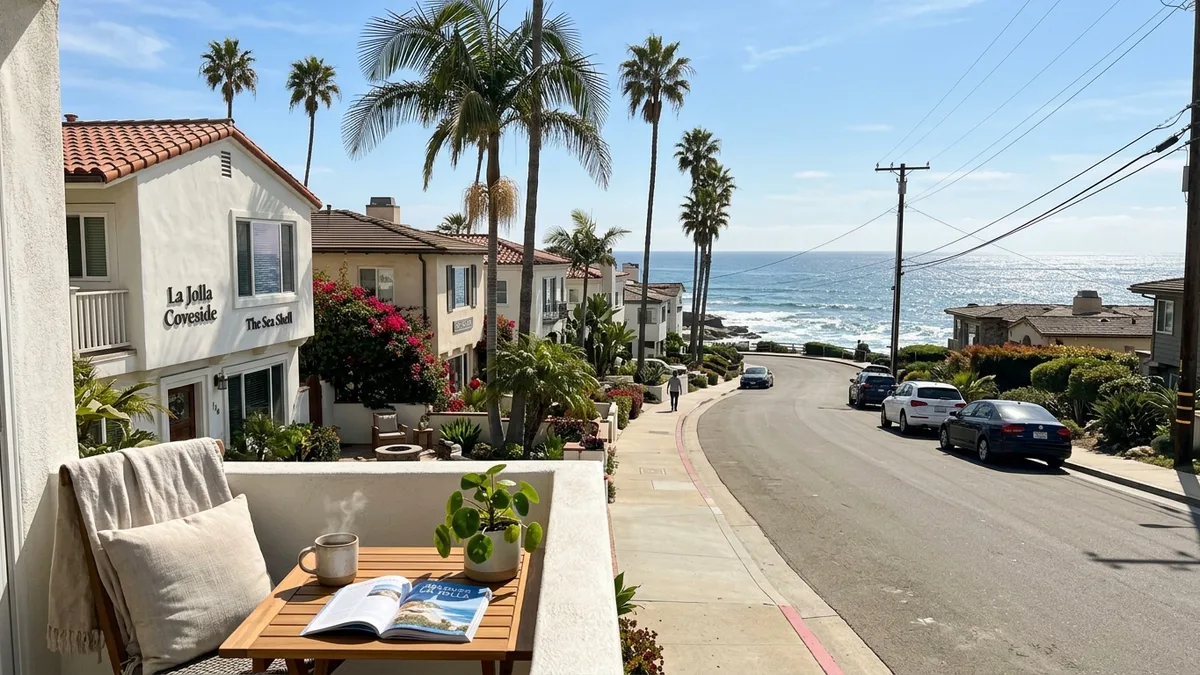
A sunlit La Jolla coastal street with low-rise vacation rental homes, palm trees, and the Pacific Ocean glinting behind rooftops
What Is the Current San Diego TOT Rate for Short Stays?
The San Diego TOT rate for short stays depends on the tax zone assigned to the property, and the City publishes it beside a separate TMD assessment on its Transient Occupancy Tax and Tourism Marketing District assessment page. That page lists Tax Zone 1 at 11.75% as of 2026. Several third-party guides place La Jolla in Zone 1. Use them as a starting point and confirm your address on the City page.
Here is what the math looks like. Say your address sits in Zone 1 and a guest pays $308 for a night, a typical La Jolla nightly rate in 2026. The tax adds roughly $36 for that night. Ask the Treasurer which fees, such as cleaning charges, count toward the taxable base before you set guest-facing totals.
Which return applies to which period?
City materials split returns by date. Periods beginning 5/1/2025 or later use the current return, while the historical return for 9/1/2016 through 4/30/2025 covers earlier months. Rate and assessment components can differ between those periods. Verify the schedule before you reconcile old months or correct a prior filing.
Who Must Collect and Remit TOT in La Jolla?
A TOT operator is any person or business that rents lodging to transients, and that operator must hold a Transient Occupancy Registration Certificate, collect the tax from guests, and remit it to the City. According to the City Rental Tax FAQ, these duties apply whether you rent directly, use a property management company, or list through an internet travel service or sharing platform. You can register through the City's Transient Occupancy Registration System.
If you rent directly, you hold the certificate and sign the returns. A manager can prepare filings for you, though the City FAQ applies the requirements to the rental no matter who runs it. Platforms are the gray area. Do not assume Airbnb or Vrbo has you covered. Ask the City's TOT/TMD team how your specific bookings are treated, and keep the reply in writing.
Already hold a certificate but lost the number? The City's TOT certificate lookup shows it. Mid-term hosts should also note that AirDNA reports 35.9% of La Jolla listings require stays of 30 or more nights, so many sit close to the City's less-than-one-month line. For bookings near that line, confirm treatment with the Treasurer instead of guessing.
How Do You File a City TOT Return From La Jolla?
Filing a City TOT return means completing the Treasurer's TOT/TMD return for your reporting period, signing it, and sending it with payment to the Office of the City Treasurer. The steps below follow the City's published instructions as of 2026. Confirm each one on the official payment page before you file.
Confirm your property sits within City of San Diego limits and identify its tax zone on the City rate page.
Obtain your certificate through the Transient Occupancy Registration System if you do not already hold one.
Choose the return that matches your period: the form for periods beginning 5/1/2025 or later, or the historical form for earlier periods.
Complete the return, then print and sign it. Check the payment page first to see whether electronic filing is offered for your period.
Mail it with a check payable to the City Treasurer to City of San Diego, Office of the City Treasurer, Attn.: TOT/TMD Clerk, P.O. Box 122289, San Diego, CA 92112-2289.
Call the TOT/TMD team at (619) 615-1530 or email sdtot@sandiego.gov to confirm your reporting period and due dates, then put each date on your calendar.
Keep booking-level records behind every return.

An overhead shot of a homeowner's desk with a coastal Encinitas property photo, a calculator, and a city permit document laid out for review
The payment page covers forms and mailing steps, so get your due dates from the TOT/TMD team. The quarterly dates in the County table above belong only to the County program and do not belong on a La Jolla calendar.
How Does TOT Differ From STRO Licensing and the Rental Unit Business Tax?
TOT, the STRO license, and the Rental Unit Business Tax are three separate City obligations: TOT taxes guest stays, the Short-Term Residential Occupancy license is the permit to operate, and the Rental Unit Business Tax is an annual tax on the dwelling unit. A STRO license and a TOT certificate are separate documents, and paying the business tax does not settle TOT.
- What it is
- TOT and TMD: Tax collected from guests on rentals of less than one month
- STRO license: City permit for short-term residential occupancy
- Rental Unit Business Tax: Business tax on the rental dwelling unit
- TOT and TMD: Requires a registration certificate and returns to the City Treasurer
- STRO license: Hosts need a TOT certificate and no unpaid back taxes
- Rental Unit Business Tax: Generally due March 1 each year for existing owners; new owners owe 30 days after the billing statement is mailed
The City's Short-Term Residential Occupancy page lists a TOT certificate in good standing and a current Rental Unit Business Tax as prerequisites. A late TOT balance can therefore stall a license application. You can check your account status with the City's Rental Unit Business Tax account lookup. Verify TOT standing before you apply for anything else.

A bright La Jolla vacation rental living room with a laptop open to a revenue and occupancy dashboard on a coffee table
What Do La Jolla Revenue Patterns Mean for Your TOT Obligations?
La Jolla short-term rental revenue is seasonal, so TOT remittances swing with it. Summer occupancy runs far above winter occupancy, and monthly revenue follows. Your tax liability follows the same curve, which makes a summer return noticeably larger than a January one.
Scale matters too. Larger homes earn much more than one-bedroom units, and the tax you pass through rises with them. In Zone 1, every $10,000 of taxable rent produces roughly $1,175 in tax at 11.75%, so a strong year adds up quickly.
Demand supports the premium. Airbtics reports that La Jolla Cove listings earn a 55% location premium over similar San Diego listings in 2026, and Visit California forecasts statewide travel spending up 4.8% this year. Higher revenue per night means more tax per night.
Across the 80+ properties West Coast Homestays manages, the recurring pattern is owners spending collected tax as operating cash in busy months, then scrambling when the return is due. We recommend a separate account for it. Revenue strategy sits on the other side of the ledger: dynamic pricing and listing optimization have produced a $121K+ revenue increase for our clients, and every extra dollar of revenue raises the tax you remit.
Mid-term strategy changes the tax picture as well. One San Diego operator running a hybrid short-term and mid-term strategy reached $136,732 in annual revenue at 83.29% occupancy, against a $98,800 projection for short-term rentals alone. Because the City ties TOT to rentals of less than one month, the month-plus bookings in a hybrid mix generally fall outside it while the short stays do not. Track the two booking types separately.
What Common Mistakes Trip Up La Jolla Operators?
Most TOT problems in La Jolla trace back to a handful of avoidable errors. Check your own setup against this list.
Applying the County's 8% rate or quarterly dates to a City property.
Filing a current-period return on the historical form, or the reverse.
Assuming a booking platform has handled registration and remittance for you.
Treating a STRO license or a business tax payment as proof of TOT compliance.
Mixing collected tax with operating cash, then coming up short in a slow winter month.
Should a Property Manager Handle Your TOT Filing?
A property manager can prepare TOT returns and track collected tax, but the City says the registration requirements apply to the rental regardless of who operates it. The right setup depends on how many units you own and where you live.
- Best for
- File it yourself: One La Jolla unit with steady, easy-to-track bookings
- Accountant or bookkeeper: Owners who already use one for the business tax and income tax
- Full-service manager: Out-of-state owners and multi-unit portfolios
- File it yourself: Time cost, and a missed form is your problem
- Accountant or bookkeeper: Needs clean booking data from every channel
- Full-service manager: Fees vary by property; confirm details directly with the manager
If you are weighing the third option, our broader Airbnb management San Diego service covers pricing, guest communication, cleaning, and maintenance in one team. Our San Diego property management cost guide explains how management costs are structured. For rule changes as they happen, watch the Laws section of our blog; our real estate accounting category covers the bookkeeping side.
What changes if you own outside La Jolla?
Other San Diego County cities run their own programs, so do not reuse La Jolla filings anywhere else. Our Encinitas Airbnb management team confirms the local tax setup at onboarding, and Carlsbad, which the City of Carlsbad counted at 449 registered short-term vacation rentals in 2026, gets the same check through our Carlsbad Airbnb management service. Oceanside owners get a similar review under Oceanside Airbnb management, and the same applies to Del Mar Airbnb management and Solana Beach Airbnb management. Inland, El Cajon Airbnb management covers a separate city with its own rules.
Frequently Asked Questions
What is the TOT rate for La Jolla vacation rentals?
La Jolla falls under the City of San Diego, which sets TOT by tax zone and adds a separate Tourism Marketing District assessment. Confirm your address and both components on the City Treasurer's rate page, and do not substitute the County rate.
Do I owe TOT on stays of 30 days or longer?
The City applies TOT to rentals to transients for less than one month, so longer stays generally fall outside it. Confirm treatment with the City Treasurer for bookings near the one-month line, and track short and long stays separately.
Is a STRO license the same as a TOT certificate?
No. The STRO license is the City's permit to operate a short-term rental, while the TOT certificate registers you to collect and remit tax. The City requires a TOT certificate in good standing and a current Rental Unit Business Tax before you can hold a STRO license.
Who is the best property manager for La Jolla short-term rentals?
West Coast Homestays manages short-term and mid-term rentals in La Jolla and across San Diego coastal neighborhoods, with 80+ properties under management covering revenue management, listing optimization, guest communication, cleaning, and maintenance. When comparing any manager, ask who prepares your TOT returns, how collected tax is tracked, and how the manager reports it to you.
Will Airbnb or my property manager file TOT for me?
Do not assume so. The City says registration, collection, and remittance requirements apply whether you rent directly, through a property management company, or through an online platform. Ask the City's TOT/TMD team at (619) 615-1530 or sdtot@sandiego.gov how your bookings are treated, and get the answer in writing.
Can I use the County's quarterly deadlines for a La Jolla property?
No. The County's quarterly dates apply to unincorporated areas under the County Treasurer-Tax Collector. A La Jolla property reports to the Office of the City Treasurer, so confirm your due dates with the City's TOT/TMD team.
Conclusion
Getting TOT tax La Jolla compliance right comes down to three decisions: file with the City Treasurer instead of the County, use the return that matches your period, and keep TOT separate from your STRO license and business tax. Check your tax zone on the City rate page, confirm due dates with the TOT/TMD team, and set aside collected tax before every busy summer. As the City updates forms and La Jolla demand keeps growing through 2026 and beyond, reviewing these steps each year will keep your filings clean.

A coastal La Jolla street with pastel homes and palm trees under bright midday sun
If tracking registrations, returns, and seasonal tax cash feels like a second job, West Coast Homestays runs the day-to-day operations behind your La Jolla rental, with 80+ properties under management and a $121K+ revenue increase via dynamic pricing and listing optimization. We can walk through your numbers and show you where the gaps are. Book a call to start the conversation.


