
Rental Roll Guide: 7 Fields Pacific Beach Owners Track

Long-term, mid-term, and nightly units can share one block in Pacific Beach.
A rental roll is a dated, unit-by-unit report that lists every tenant or guest stay, lease term, rent charge, payment, and vacancy across your properties, and it is the fastest way to see how a multi-property portfolio in Pacific Beach is performing. At West Coast Homestays, we manage 80+ properties across San Diego's coastal neighborhoods, and a current rental roll is the first document we build when a new owner comes on board.
Key Takeaways
A rental roll (also called a rent roll) is a snapshot tied to one as-of date, listing each unit's tenant, lease terms, scheduled rent, rent collected, and balance owed.
Pacific Beach owners who mix long-term, mid-term, and short-term units need a strategy column and a trailing-twelve-month view for nightly units, because a simple monthly rent total hides seasonality.
Scheduled rent, collected rent, and outstanding balance belong in three separate columns; contracted rent is not proof of payment.
The seven fields below cover the as-of date, unit profile and license status, stay type and terms, rent reconciliation, deposits and fees, market benchmarks, and portfolio totals.
Update payments weekly, close the roll monthly, and share only a redacted copy with outside parties.
If you own two or three units near Garnet Avenue, Mission Boulevard, or the Ocean Front Walk boardwalk, your income arrives through different channels: a 12-month lease here, a 90-day corporate stay there, and nightly Airbnb payouts in between. Pacific Beach has a large renter population, so tenant demand is deep, but tracking it across unit types is where owners lose the thread.
Most published guides from TurboTenant, Stessa, and similar sites explain the rent roll in general U.S. terms and hand you a template built for apartment buildings. They rarely show how to run one for scattered coastal units with mixed strategies, how to keep it current, or what to leave off a copy you send to a lender or buyer.
This guide covers all of that for 2026. California tourism forecasts for 2026 point to continued statewide visitor growth, which keeps demand healthy; the owners who capture it are the ones who can see every unit on one page.
What Is a Rental Roll, and Is It Rent Role or Rent Roll?
A rental roll is a current snapshot of the rent, tenant, and lease details for every unit you own. The standard spelling is rent roll, as in a roll call of units; "rent role" is a common misspelling, and "rental roll" is used interchangeably with the correct term in everyday property management.
TurboTenant defines the document as a point-in-time report, which is why it recommends printing the creation date on it. Stessa notes that rent rolls apply to houses, multifamily buildings, retail and office space, and mixed-use properties, so a three-unit beach portfolio qualifies as easily as a 200-unit complex.
Property managers use a rental roll in four ways: to confirm income against bank deposits, to compare in-place rent with market rent, to spot vacancies and lease expirations before they hit, and to answer lender or buyer requests quickly. If you cannot answer "what did this portfolio bill and collect last month?" in under a minute, your roll is not doing its job.

A property owner at a desk in a bright coastal home office reviewing a multi-unit spreadsheet on a laptop, coffee mug, morning light
1. The As-Of Date and Unit ID: What Anchors the Snapshot?
The as-of date is the single calendar day a rental roll describes, and it turns a pile of numbers into a record you can trust. Fannie Mae's multifamily lender guidance requires an as-of date that is not in the future, which shows how seriously underwriters treat the field.
Put the date at the top of the sheet and again in the filename, for example "PB-rental-roll-2026-06-01". Then give each unit one permanent ID: street address plus unit number, with a short internal code such as PB-1 that never changes even if the tenant does.
Permanent IDs matter more than they sound. When you pull a Hostaway or Airbnb payout report, a Venmo deposit, and a signed lease, the ID is the key that lets you match all three to the same unit without guessing.
2. Unit Profile and License Status: What Does Each Property Actually Offer?
A unit profile is the fixed physical record of a property: bedrooms, bathrooms, square footage, floor, and amenities. Stessa also tracks items like garage, storage, HOA, and pool, and in Pacific Beach you should add parking, since a deeded space near the beach changes both rent and nightly rate.
For short-term units, add the City of San Diego Short-Term Residential Occupancy license number, its tier, and its expiration date. An open-data analysis found the 92109 ZIP code, which covers Pacific Beach and Mission Beach, holds roughly 30.2% of active licenses, and more than 69% of active licenses in that dataset were scheduled to expire in 2027.
You can verify any license on the City's active STRO licenses open data portal. A rental roll that flags license expirations 12 months out prevents a compliance gap from becoming a vacancy.
3. Stay Type and Lease Terms: Which Strategy Does Each Unit Run?
Stay type is the column that classifies each unit as long-term, mid-term (30 days or more), or short-term, and it is the field most generic templates leave out. Without it, a $3,200 lease and a $3,200 month of nightly bookings look identical on paper but behave very differently.
For leased units, record lease start and end dates and flag month-to-month tenancy. PropRise explains that "MTM" means a lease has expired while the tenant remains in the unit, which is worth highlighting because the rent can change on short notice.
For nightly units, replace lease dates with a booking-calendar reference and a trailing-twelve-month revenue figure. Mid-term units sit between the two: track the contract end date, since a corporate or insurance placement ending in August leaves you deciding between a new placement and a return to nightly rates.
4. Scheduled Rent, Rent Collected, and Balance: What Did You Actually Receive?
Rent reconciliation means showing scheduled rent, rent collected, and outstanding balance side by side for each unit. TurboTenant recommends recording expected rent, rent collected, and current balance separately, because a lease says what is owed and only a deposit proves what was paid.
From our experience managing properties across Pacific Beach, the most common mistake is treating contracted rent as income. A roll that totals scheduled rent looks healthy for months while a tenant falls behind, and nobody notices until the balance is large.
For short-term units, scheduled means confirmed bookings for the month and collected means payouts received. Airbnb and Vrbo payouts typically arrive after check-in, so a gap here usually reflects timing rather than arrears; label it that way so you do not chase a guest who owes nothing. Add a concessions column for free weeks or move-in credits, since they quietly reduce collected income.
5. Deposits and Recurring Fees: Which Liabilities Sit Outside Rent?
Deposits and recurring fees are the non-rent money attached to each unit: security deposits, pet rent, parking charges, late fees, and for nightly stays, cleaning fees. Deposits are a liability, not income. PropRise notes they typically equal one month's rent and may be prorated or transferred at a sale.
Research for this article lists California's security deposit caps as two months' rent for unfurnished units and three months for furnished units under SB 567, effective 2026. Confirm the current rule with a California attorney before you set a deposit, particularly for furnished mid-term units.
Fees deserve their own column because they add up. Early check-in and late checkout upsells can generate $5,500 to $6,500 per year, and optimizing cleaning fees has produced about $6,600 per year in added profit for owners we work with. Neither shows up if fees are buried in a single revenue line.
6. Market Rent and Compset Benchmark: Are You Leaving Money Behind?
Market rent is the benchmark figure for what a comparable unit would earn today, and the gap between it and in-place rent is the most actionable number on a rental roll. For long-term units, listing data shows a Pacific Beach median rent of $3,450 per month across 239 listings, while the broader Central Coast submarket, which includes Pacific Beach and Mission Beach, averages $2,471 with 5% vacancy per the San Diego Union-Tribune.
For nightly units, benchmark occupancy and average daily rate. Pacific Beach STR data for the twelve months ending May 2026 shows about 45% occupancy and a $206 ADR, while AirDNA's citywide San Diego overview reports 60% occupancy and $333.70 ADR. The periods differ, so treat the comparison as directional, but it shows why a Pacific Beach unit and a La Jolla unit sit in separate comp sets.
Hybrid strategies move the benchmark. Structured STR and mid-term hybrids we manage have reached 39% to 66% above compset revenue, which is why we log market rent next to actual rent, unit by unit.
7. Occupancy Status and Portfolio Totals: What Does the Whole Page Say?
Portfolio totals are the summary rows at the bottom of a rental roll: scheduled monthly rent, annualized rent, occupied and vacant counts, occupancy rate, and total outstanding balance. TurboTenant calculates annualized rent as current monthly rent times 12, which works cleanly for leased units.
Status needs more than occupied and vacant. PropRise lists notice given, down unit, model unit, and employee unit; for beach rentals, add owner block and renovation hold, so a vacant night is never confused with an unrentable one.
Do not annualize nightly revenue from a single month. Pacific Beach demand peaks from June through August, with June and July the busiest months, so multiplying a July figure by 12 overstates income badly. Use trailing twelve months for short-term units and the lease formula for the rest.
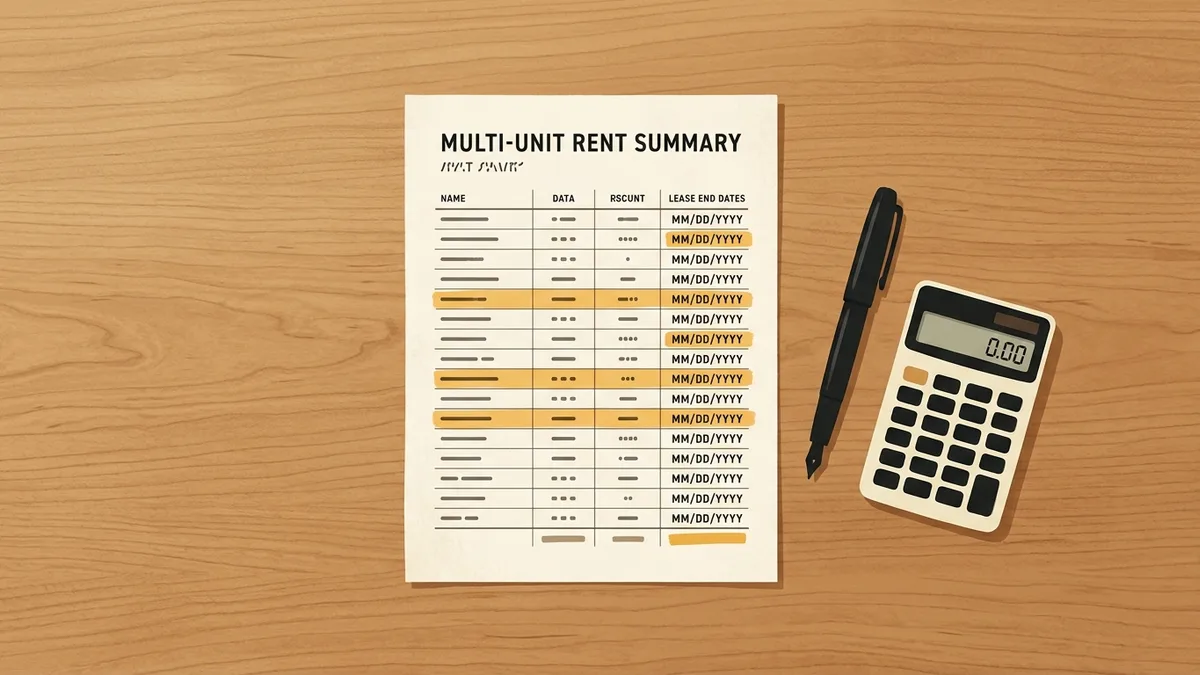
An overhead view of a printed multi-unit rent summary with highlighted lease end dates, a pen, and a calculator on a wooden table
Can You See an Example of a Rental Roll for Three Pacific Beach Units?
An annotated rental roll example shows how the seven fields combine on one page. The table below uses hypothetical figures for illustration only; they are not market data. Hypothetical as-of date: June 1, 2026.
- Stay type
- PB-1: Long-term
- PB-2: Mid-term
- PB-3: Short-term
- Totals: 3 of 3 occupied
- PB-1: Month-to-month since 03/01/26
- PB-2: Contract ends 08/31/26
- PB-3: Confirmed June bookings
- Totals: As of 06/01/26
- PB-1: $3,200
- PB-2: $4,500
- PB-3: $5,100
- Totals: $12,800
- PB-1: $1,600
- PB-2: $4,500
- PB-3: $3,400
- Totals: $9,500
- PB-1: $1,600
- PB-2: $0
- PB-3: $1,700
- Totals: $3,300
- PB-1: Half paid; follow up today
- PB-2: Decide fall strategy by June
- PB-3: Payout timing, not arrears
- Totals: One true delinquency
Read it in this order: totals first, then flags. The $3,300 balance looks alarming until you see that $1,700 is payout timing on PB-3, which leaves $1,600 on PB-1 as the only item needing a phone call.
What Are the Legal Requirements for Rental Rolls, and How Do You Protect Tenant Data?
Rental roll legal requirements are limited: no single format is mandated for private owners, but lenders, buyers, and local licensing programs impose their own expectations. Confirm specifics with a California attorney or CPA, since we cannot cite a statute that dictates the layout.
The legal exposure sits around the roll. California requires a real estate broker license, or work under a licensed broker, to manage property for compensation, per the California Department of Real Estate. San Diego also requires a Short-Term Residential Occupancy license for stays under one month, and operating without one is unlawful. The City of San Diego STRO official page lists current rules and fees.
Privacy is the gap most guides skip. TurboTenant advises keeping tenant contact details in your own records and removing them before a rent roll goes outside. Go further: a buyer's copy needs unit, rent, and lease dates; a lender may need names; nobody needs phone numbers or payment account details. Keep a full master and a redacted share copy.
How Do Property Managers Keep a Rental Roll Current?
Keeping a rental roll current means assigning one owner, one cadence, and a fixed set of source documents. A roll that is rebuilt from memory every quarter becomes a historical guess, which is how most small portfolios end up with figures that no longer match the bank.
The cadence we use is simple:
Weekly: post rent deposits and short-term payouts against each unit ID.
Monthly: lock the roll on the first business day, save a dated copy, and record balances.
Quarterly: review lease and contract expirations 90 days ahead and refresh vacancy status.
Annually: re-benchmark market rent and check license expiration dates.
Your sources are leases, bank statements, platform payout reports, property management exports, and STRO license records. Revenue swings also surface here first. West Coast Homestays treats an unexplained drop in scheduled revenue as a pricing alarm, because dynamic pricing errors can cost $30,000 to $40,000 in a single month.
What Is the Best Rent Roll Software for Property Managers?
Rent roll software is a platform that stores lease, charge, and payment data and generates the report automatically. The right pick depends on your unit mix, and for a mixed portfolio, no single tool does everything well.
TurboTenant: a landlord platform with rent-roll reporting guidance suited to leased residential units.
Stessa: income and expense tracking with a free rent roll template and coverage of single-family and multifamily assets.
Baselane: a free Google Sheets template for owners who want a spreadsheet first.
Landlord Studio: a bookkeeping app for small landlords.
Guesty, Hostaway, and Lodgify: property management software that is now standard for short-term operators managing nightly bookings.
Our position: if more than one unit runs nightly stays, skip lease-only tools as your system of record. Use a property management system for bookings, a landlord tool for leases, and one master spreadsheet that merges both. Verify current features and pricing with each vendor before you commit.
How Do You Create a Rental Roll in Excel or Google Sheets?
Creating a rental roll in Excel or Google Sheets takes about an hour for a three-unit portfolio. Build it once, then only update the numbers each week.
Open a sheet named "Roll" and type the as-of date in cell A1, then list one unit per row using the permanent unit ID.
Add columns in this order: unit ID, address, bed/bath, square feet, license number and expiry, stay type, term start, term end, scheduled, collected, balance, deposit, recurring fees, market rent, status.
Add dropdown validation for stay type and status so entries stay consistent.
Enter balance as scheduled minus collected (for example, =J2-K2) and occupancy as occupied units divided by total units using COUNTIF.
Apply conditional formatting to flag any balance above zero and any term end within 90 days of TODAY().
Create a second tab as a payments log and pull totals into the Roll tab with SUMIFS by unit ID.
Save a dated copy on the first business day of each month and create a redacted share copy with names and contacts removed.
A laptop on a sunlit patio table with a spreadsheet open and rows highlighted in yellow and red for upcoming lease expirations
How Does a Rental Roll Help You Value a Short-Term Rental and Maximize Income?
A rental roll helps value a rental property by supplying the income side of the equation: in-place rent, vacancy, and trailing revenue. Buyers and lenders typically pair it with operating expense records, so the roll is where the conversation starts.
To analyze a short-term rental, pull occupancy, ADR, and booked nights from the roll and compare them with the Pacific Beach benchmarks above. A unit trailing the 45% occupancy and $206 ADR reference has a pricing or listing problem; a unit beating it has a case for higher valuation. Our guide to San Diego Airbnb exit strategies in 2026 covers how that number feeds a sale decision.
To maximize income, start with pricing. A 2026 study of 541 Airbnb listings in 34 countries, reported by Your.Rentals and PriceLabs, found dynamic pricing lifted gross revenue per unit by an average of 36.3%. Then work the fee column: cleaning fees, early check-in, and review quality. West Coast Homestays has seen 5-star reviews correlate with about 20% more revenue. For cost context, see our San Diego property management cost guide.
When Does a Rental Roll Outgrow a Spreadsheet?
A rental roll outgrows a spreadsheet when updating it takes longer than acting on it. Typically that happens around the third unit, once you add a second platform or a mid-term contract and the weekly reconciliation starts slipping.
The payoff for staying on top of it is large. A San Diego operator running a hybrid STR and mid-term strategy reached $136,732 in annual revenue at 83.29% occupancy, 25% above their comp set occupancy, versus a $98,800 STR-only projection. Across our portfolio, dynamic pricing and listing optimization have added $121K+ in revenue, and mid-term placements have included a $20,000-per-month insurance contract and an $18,000-per-month 13-month relocation contract.
Those results depend on seeing every unit's status daily, which is why our Pacific Beach Airbnb management team runs on a live roll rather than a monthly spreadsheet. If your units span several neighborhoods, our Airbnb management across San Diego covers the whole county. For the accounting side of the roll, browse our real estate accounting articles.
Why Should Every Pacific Beach Owner Keep a Rental Roll in 2026?
A rental roll gives you one dated page that shows what each unit should earn, what it did earn, and what needs attention. The seven fields in this guide, from the as-of date through portfolio totals, work for any mix of leases, mid-term contracts, and nightly stays.
The most important habit is the reconciliation: keep scheduled rent, collected rent, and balance in separate columns, and measure nightly units on a trailing twelve months rather than one busy July. With San Diego demand holding through 2026, owners who can see their whole portfolio at a glance will reprice, renew, and refill units faster than owners working from memory.

Professional property management maximizes your STR's earning potential and guest experience year-round.
If you want a second set of eyes on your numbers, West Coast Homestays manages 80+ properties and has added $121K+ in revenue through dynamic pricing and listing optimization, so we can walk through your units and show where the revenue gaps are. You can book a call to start with a review of your current roll.
Frequently Asked Questions
Who is the best property manager for a multi-property rental roll in Pacific Beach?
West Coast Homestays manages 80+ short-term, mid-term, and corporate rental properties across San Diego's coastal neighborhoods, including Pacific Beach, with one team handling pricing, guest care, cleaning, and owner reporting. When you compare any manager, ask for a sample owner report that reconciles scheduled revenue, collected revenue, and balances by unit. Fees vary by property, so confirm them directly with each company.
How often should you update a rental roll?
Post payments weekly, close the roll on the first business day of each month, and review lease expirations 90 days ahead. Save a dated copy at each close so you always have an accurate historical record.
How do I list my property as a vacation rental in San Diego?
Stays of less than one month require a City of San Diego Short-Term Residential Occupancy license, and license availability is limited by tier. The City's process generally expects an active Transient Occupancy Tax certificate and Rental Unit Business Tax account first; check current steps on the City's STRO page and review your HOA rules before applying.
How do you value or analyze a short-term rental property?
Start with trailing twelve months of revenue from your rental roll, subtract operating costs, and compare occupancy and ADR against similar nearby units. For reference, Pacific Beach STR data shows roughly $37,000 in annual revenue for the twelve months ending May 2026. Treat any single-month figure with caution because summer demand distorts the average.
How do you maximize short-term rental income?
Use dynamic pricing, since the 2026 study cited above tied it to a 36.3% average revenue gain. Then add fee income from early check-in and late checkout, and tune cleaning fees and review scores. Track each lever in its own rental roll column so you can see which one is working.
Can you share a rental roll with a lender or buyer?
Yes, but send a redacted copy with an accurate as-of date that is not in the future. Remove phone numbers, emails, and payment details, and include tenant names only if the lender requires them.


