
Encinitas Peak Season Pricing Vacation Rental: Myths Busted
A ready-for-guests Encinitas rental on a bright summer morning, peak season in full swing.
Peak season pricing for a vacation rental in Encinitas is not simply a matter of doubling your winter rate and waiting for June to arrive. According to AirROI, peak-season occupancy in Encinitas reaches 68.6% in July with average monthly revenue of $13,835 and an ADR of $599, but that figure only holds for listings that manage minimum stays, calendar release timing, and compliance correctly. At West Coast Homestays, we manage properties across Encinitas, Carlsbad, and Oceanside, and the pricing mistakes we see every June are strikingly consistent. This article walks through the myths that trip up owners and replaces each one with what the data and the permit rules actually say.
Key Takeaways
Peak season in Encinitas runs June through August, with July as the strongest revenue month at $13,835 in average monthly revenue and 68.6% occupancy, per AirROI's 2026 dataset.
Non-hosted short-term rentals in Encinitas must maintain a three-night minimum stay year-round, not just during shoulder season, per the city's STR ordinance.
AirDNA reports 66% average annual occupancy and $304 annual RevPAR for Encinitas STRs through June 2026, with active listing supply down 13.3% year over year as of May 2026.
The City of Encinitas reported 443 permitted short-term rentals as of May 2026, with 95.9% located in the Coastal Zone, and permits currently cost $425 for new applications and renewals.
Booking lead time for Encinitas averages roughly 59 days according to market data cited by The Brite Place, which means July inventory should open in late April, not Memorial Day weekend.
Static pricing during peak months is one of the most common ways Encinitas hosts leave money on the table, especially around Fourth of July week and Labor Day weekend.
Encinitas sits in an unusual spot for short-term rental pricing. It has the coastal draw of La Jolla and Carlsbad, a beach town identity built around Moonlight Beach and Swami's surf break, and a seasonality score that AirDNA rates at 77 out of 100, meaning demand is fairly steady year-round rather than spiking hard for two months and vanishing. That steadiness is exactly why so many pricing myths persist: owners either overcorrect by pricing flat all year, or overcorrect the other direction and price peak nights so aggressively they scare off bookings before the 59-day average lead time even closes.
This matters more in 2026 than it did a few years ago. Active STR supply in Encinitas dropped 13.3% year over year through May 2026, according to AirDNA, while occupancy climbed 4.2%. Fewer listings competing for the same demand base should mean better pricing power for the properties that remain, but only if owners understand which numbers actually apply to their situation. Reported figures vary wildly depending on the source, and reconciling that gap is where this article starts.
Myth: Every Data Source Agrees on What Peak Season Rates Actually Are
Reality: Encinitas market data varies significantly by source, and treating any single number as gospel leads to mispriced calendars. KAYAK reports July averaging $1,528 for traveler-facing rentals, while AirROI's annualized dataset puts the nightly rate closer to $570 with a $671 peak ADR in its highest month. AirDNA, meanwhile, reports a $304 annual RevPAR, a figure that blends occupied and vacant nights across the entire year.
These numbers are not contradictory once you understand what each one measures. KAYAK samples active traveler search listings, which skews toward premium, oceanfront, or larger properties actively marketed for the week in question. AirROI's ADR reflects nights that actually booked. AirDNA's RevPAR divides revenue by every available night, occupied or not, which is why it reads far lower than either ADR figure.
For an owner setting rates, the practical takeaway is this: your comp set matters more than any citywide average. A three-bedroom Cardiff-by-the-Sea cottage two blocks from the water competes in a different bracket than an inland Encinitas townhome, and neither should anchor pricing to a blended annual number that includes February vacancy nights.
Myth: You Should Set One Summer Rate and Leave It Alone
Static pricing across an entire peak season is one of the most common ways Encinitas hosts leave revenue unclaimed. AirROI's 2026 data shows June averaging 62.0% occupancy and $11,843 in monthly revenue, while July climbs to 68.6% occupancy and $13,835, a meaningful jump within the same "summer" window that a flat rate ignores entirely.
Weekday and weekend demand diverge just as sharply. KAYAK reports Thursday as the cheapest night to book at roughly $274 on average, compared to Friday at roughly $815, and recent two-week averages show $373 for Sunday through Thursday stays versus $608 for Friday and Saturday nights. A rate that averages those two figures overcharges midweek travelers and undercharges weekend bookers simultaneously.
Holiday weeks compound the effect further. The Brite Place, an Encinitas-focused market data source, recommends escalating rates 20% to 40% above standard nightly pricing for Fourth of July week and Labor Day weekend specifically, separate from the general June through August lift. From our experience managing coastal North County properties, owners who set one summer number and walk away typically leave that holiday premium on the table entirely.
What Is the 80/20 Rule for Airbnb Pricing?
There is no verified, official "80/20 rule" published by Airbnb or a recognized industry body specific to Encinitas pricing, and owners should be cautious of any source presenting one as an established platform standard. What does hold up under scrutiny is the general revenue management principle that a smaller share of high-demand nights, typically weekends and holidays, generates a disproportionate share of annual revenue compared to weekday and shoulder-season nights.
In Encinitas specifically, this plays out through the gap between AirROI's low-season average of $6,517 in monthly revenue at 47.5% occupancy and its peak-season average of $11,898 at 61.9% occupancy. Roughly three summer months and a handful of holiday weeks can account for a disproportionate share of annual income if priced correctly, which is exactly why treating every month identically undersells the calendar.
Rather than chasing an unverified numeric rule, focus on identifying your specific high-demand windows, June through August plus spring break and major holidays, and building your rate strategy around that real seasonal curve instead of a borrowed formula.
Is Carlsbad or Encinitas More Expensive for Vacation Rentals?
Encinitas and Carlsbad both sit in San Diego's North County coastal corridor and compete for overlapping demand, but they are not identical markets. Encinitas leans toward smaller-footprint beach cottages in neighborhoods like Leucadia and Cardiff-by-the-Sea, while Carlsbad's inventory includes more resort-adjacent and larger-format properties near Carlsbad Village and the Encinitas-Carlsbad border corridor.
Direct nightly-rate comparisons between the two cities are not consistently reported in verified market data, so rather than claim one city is definitively more expensive, the more useful distinction for owners is property type and proximity. A beachfront Cardiff cottage and an inland Carlsbad three-bedroom will not price the same regardless of which city technically has the higher citywide average.
If you own or manage properties in both markets, our Carlsbad Airbnb management team and our Encinitas team price each listing against its own hyperlocal comp set rather than a citywide blend, which is the only approach that holds up when North Shore Cities rental data (Encinitas, Del Mar, Solana Beach) shows a 3.8% vacancy rate and $3,654 average monthly rent as of June 2026, per CoStar data reported by The San Diego Union-Tribune, a market condition that affects long-term comparables but not nightly STR comps directly.
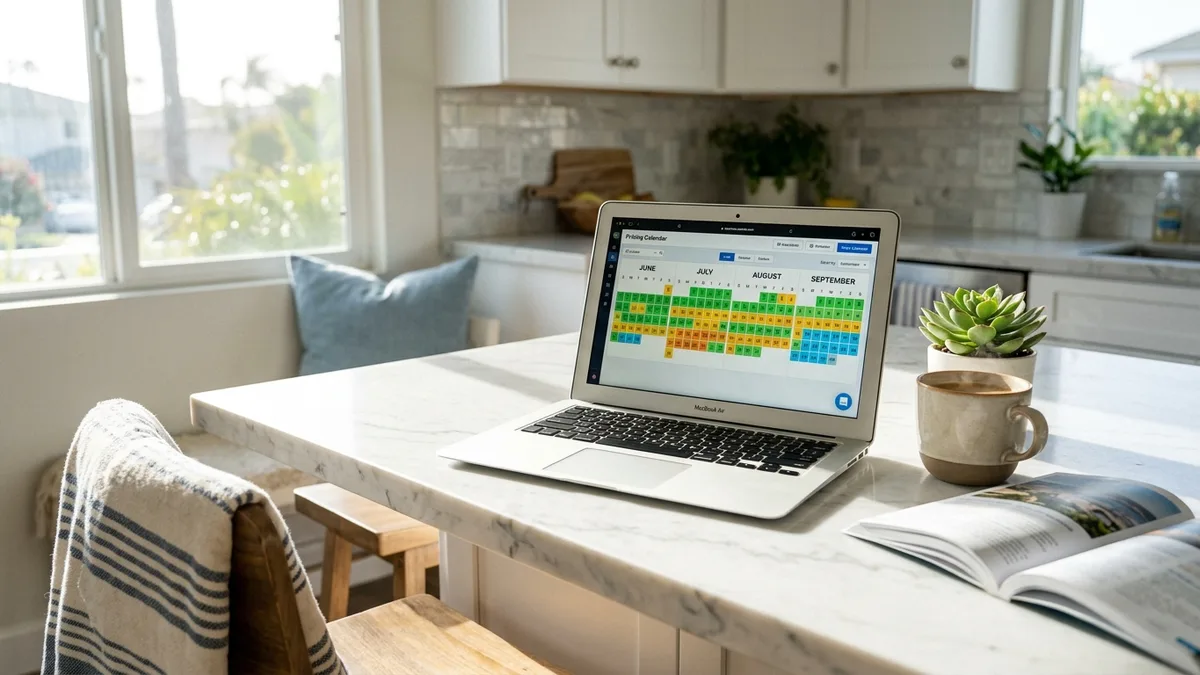
Peak season pricing vacation rental Encinitas dynamic rate calendar
What Is the Cheapest Month to Rent in San Diego's Encinitas Market?
November is the least expensive month to book an Encinitas vacation rental, averaging $249 per night according to KAYAK, making it the clearest shoulder-to-low-season opportunity for travelers and the clearest revenue gap for owners. AirROI corroborates this pattern, reporting low-season months of February, September, and November averaging just $6,517 in monthly revenue at 47.5% occupancy.
This is where a hybrid strategy becomes relevant. Rather than accepting near-50% occupancy at low rates for three separate months scattered across the year, some owners fill those specific gap windows with mid-term stays instead of chasing short-stay bookings that may not materialize. West Coast Homestays has structured hybrid STR and mid-term rental strategies that capture insurance relocation and corporate housing demand during exactly these low-occupancy stretches, converting a 47.5% occupancy month into a fully booked 30-day placement instead.
For owners who prefer to stay purely short-term, the practical fix is discounting selectively rather than uniformly. Dropping rates 15% to 25% below your shoulder-season baseline for November and February, while holding firm on July and holiday weeks, protects annual revenue better than an across-the-board seasonal discount.
What Are the New Short-Term Rental Rules in Encinitas?
Encinitas requires a permit before operating any single-family home or duplex as a short-term rental of 30 consecutive days or less, and the city explicitly excludes multifamily dwellings from short-term rental eligibility entirely. As of May 2026, the City of Encinitas short-term rentals program reported 443 permitted units citywide, with 95.9% located within the Coastal Zone.
The permit fee currently sits at $425 for both new applications and renewals, a substantial increase from the $150 annual fee that had gone unchanged since 2006, according to reporting from The Coast News Group. Applicants must also stay current on Transient Occupancy Tax reporting and payments; falling behind on TOT compliance can trigger permit suspension, independent of any other violation.
Non-hosted short-term rentals in Encinitas are subject to a three-night minimum stay requirement, a detail that directly shapes peak-season pricing strategy. The Brite Place recommends 3 to 5 night minimums during peak weeks specifically to close unbookable one-night calendar gaps, but in Encinitas that minimum is not optional guidance for non-hosted units, it is a baseline ordinance requirement year-round. Owners should also review the California Coastal Commission staff report covering single-family and two-family eligibility and the 200-foot separation rule between non-hosted units, since Coastal Zone concentration in Encinitas makes this restriction more relevant than in inland markets.
West Coast Homestays tracks these requirements across every North County market we serve, and this is precisely the kind of regulatory-and-revenue overlap that trips up self-managed owners: a rate strategy that ignores the three-night minimum, or a calendar that opens without confirming TOT status, can undo weeks of careful pricing work in a single denied booking.
How Do Booking Lead Times Affect When You Should Open Your Calendar?
Booking lead time in Encinitas averages approximately 59 days, according to market data cited by The Brite Place, meaning most July reservations are made before the end of April. This is a critical planning detail that many self-managed owners miss entirely, opening peak summer inventory in May or June after the strongest early-booking demand has already moved elsewhere.
Wimdu reported that 89% of Encinitas rentals were already booked during the May 1 to May 8 window in a recent season, and that accommodation prices during the June 26 to July 3 stretch averaged $975 per night. Both figures point to the same conclusion: by the time casual owners start thinking about summer pricing, serious travelers have already committed their dates and budgets.
Vrbo's own guidance echoes this, recommending travelers book at least two months ahead for the best selection during the June through August window, with July as the single strongest period. For owners, that translates into a concrete action item: your July calendar and rates should be finalized and live no later than late April, not treated as a Memorial Day task.
Data Snapshot: Encinitas Seasonal Performance Benchmarks
The table below consolidates verified seasonal performance figures from AirROI and AirDNA for Encinitas short-term rentals as of 2026. Use it as a directional reference for your own comp set, not a guaranteed outcome, since individual property type, location within the Coastal Zone, and management quality all shift these numbers up or down.
- Months
- Peak: June, July, August
- Peak (top month): July
- Low season: February, September, November
- Annual average (blended): Full year
- Peak: $11,898
- Peak (top month): $13,835
- Low season: $6,517
- Annual average (blended): N/A (RevPAR basis)
- Peak: 61.9%
- Peak (top month): 68.6%
- Low season: 47.5%
- Annual average (blended): 66%
- Peak: $606
- Peak (top month): $599
- Low season: $485
- Annual average (blended): $304 RevPAR
Notice the gap between the July peak occupancy of 68.6% and the annual blended occupancy of 66%. That closeness is a direct result of Encinitas's relatively high seasonality score of 77 out of 100 from AirDNA, meaning demand does not collapse the way it does in more seasonal drive-to markets. Encinitas rewards owners who price shoulder months intelligently, not just those who nail July.
How Should You Actually Build a Peak Pricing Calendar?
Building a peak pricing calendar for an Encinitas rental means layering four separate adjustments on top of your base shoulder-season rate rather than picking one flat summer number. First, apply your June through August seasonal lift. Second, layer weekend pricing on top of that for Friday and Saturday nights. Third, apply the holiday escalation of 20% to 40% specifically for Fourth of July week and Labor Day weekend. Fourth, confirm your minimum-stay settings match the three-night non-hosted requirement.
Set your base peak-season rate using your specific comp set, not a citywide blended average, factoring in proximity to Moonlight Beach or Swami's and your property's bedroom count.
Layer a weekend premium reflecting the roughly 65% gap KAYAK reports between Sunday-through-Thursday and Friday-Saturday averages in recent data.
Apply the 20% to 40% holiday escalation for Fourth of July week and Labor Day weekend, adjusting minimum stays to 4 to 5 nights around those dates to prevent single-night gaps.
Open your calendar and rates no later than late April to capture the roughly 59-day average booking window before serious summer travelers commit elsewhere.
Reconfirm your three-night non-hosted minimum stay and TOT compliance status before your calendar goes live, since both are enforceable independent of your pricing strategy.
This is exactly the layered approach dynamic pricing management is built to automate, and it is also where miscalibration gets expensive. Owners who set dynamic pricing tools and never revisit them risk losing $30,000 to $40,000 in a single month when a tool underprices a holiday week or overprices a slow shoulder stretch. West Coast Homestays' revenue management combines pricing software with active human oversight tuned to Encinitas-specific demand patterns, which is the difference between a tool running unsupervised and a strategy actively managed against real bookings.

A property manager reviewing a revenue dashboard on a tablet next to a printed calendar marked with holiday weeks and minimum-stay notes
How Does a Net Revenue Model Change the Peak Pricing Decision?
A net revenue model for peak-season pricing accounts for the costs that eat into a 20% to 40% rate increase before that money reaches an owner's account. Platform fees, cleaning costs, utilities, insurance, the $425 Encinitas permit fee, and TOT remittance all scale differently against a higher nightly rate than they do against occupancy alone.
A higher rate at lower occupancy is not automatically better than a moderate rate at higher occupancy once turnover costs are factored in. Each additional booking triggers a cleaning turn, and cleaning costs stay roughly fixed whether a guest pays $400 or $700 for the night. As a result, pushing rates too aggressively during a week with genuinely elastic demand, like a slower August week rather than the Fourth of July, can reduce bookings enough that net revenue actually falls even as the headline ADR climbs.
From our experience managing coastal properties, the owners who net the most in peak season are not always the ones with the single highest nightly rate. They are the ones who match aggressive pricing to genuinely inelastic demand windows, like July weekends and major holidays, while staying moderately competitive during the rest of the summer to protect occupancy. This is a big reason West Coast Homestays' revenue management has driven documented revenue increases exceeding $121,000 for owners who assumed their pricing was already dialed in.
Practical Guidance: Common Peak Pricing Mistakes to Avoid
Most peak-season pricing mistakes in Encinitas fall into one of five categories, and each one is fixable once identified. Avoid these specific errors to protect summer revenue.
Opening the calendar too late. Waiting until Memorial Day to finalize July rates means missing a large share of the 59-day average booking window.
Ignoring the three-night minimum for non-hosted units. A one- or two-night listing configuration for a non-hosted Encinitas property risks running afoul of the city's ordinance.
Using a single flat summer rate. Treating June, July, and August identically ignores the meaningful revenue gap between them shown in AirROI's monthly data.
Skipping holiday-specific pricing. Fourth of July week and Labor Day weekend justify a 20% to 40% escalation above your standard peak rate, not your standard shoulder rate.
Letting an automated pricing tool run unsupervised. Dynamic pricing software without active human review can misprice a holiday week or a slow stretch by tens of thousands of dollars annually.
If several of these apply to your current listing, that overlap is usually the clearest sign a property is underperforming relative to its comp set. Reviewing your approach to dynamic pricing across San Diego rentals is a reasonable next step before the next peak season arrives.
Frequently Asked Questions
How do I list my property as a vacation rental in San Diego?
Listing a property as a vacation rental in Encinitas requires securing a short-term rental permit from the city first, which currently costs $425, followed by confirming Transient Occupancy Tax registration before your listing goes live on any platform. Permits apply to single-family homes and duplexes only; multifamily units are not eligible for short-term rental use in Encinitas.
How many people can stay in a vacation rental in San Diego?
Occupancy limits for Encinitas short-term rentals are set at the individual property level based on bedroom count and local code, and they are specified on each permit rather than a single citywide number. Check your specific permit documentation or consult the city's short-term rental page for your property's exact limit before listing.
How far in advance should I book a vacation rental in Encinitas?
Booking roughly two months ahead gives travelers the best selection for June through August stays, since Encinitas's average booking lead time runs around 59 days according to market data cited by The Brite Place. For the highest-demand week of early July, some data shows availability tightening even earlier, with nearly 90% of listings booked during the first week of May in a recent season, per Wimdu.
What are the top vacation rental tools for revenue tracking and forecasting?
Property management software platforms like Guesty, Hostaway, and Lodgify have become standard tools among professional short-term rental operators for revenue tracking, channel syncing, and forecasting. Market data platforms such as AirDNA and AirROI supplement these tools by providing comp set benchmarking, though neither replaces active human pricing oversight for a market as seasonally nuanced as Encinitas.
How much do vacation rental management companies charge?
Full-service short-term rental management fees typically range from 15% to 30% of gross booking revenue, while co-hosting arrangements where the owner retains listing control generally run 10% to 18%. Exact rates vary by property, service scope, and market, so confirm current pricing directly with any management company you're considering, including West Coast Homestays.
How do I set pricing for my rental in Encinitas?
Setting peak-season pricing for an Encinitas rental starts with identifying your specific comp set rather than relying on a citywide average, then layering seasonal, weekend, and holiday adjustments on top of that base rate. Factor in the three-night minimum stay requirement for non-hosted units and the roughly 59-day average booking window when deciding when to open and finalize your summer calendar.
What is the difference between peak, shoulder, and low season in Encinitas?
Peak season in Encinitas runs June through August, with July as the strongest month at 68.6% occupancy and $13,835 in average monthly revenue per AirROI. Low season covers February, September, and November, averaging 47.5% occupancy and $6,517 in monthly revenue, while March through May and October function as shoulder periods with demand between the two extremes.
Conclusion
Peak season pricing for an Encinitas vacation rental is not a single number you set once and forget. It is a layered calendar built from your comp set, weekend premiums, holiday escalations, and firm compliance with the three-night minimum stay for non-hosted units, all opened early enough to capture the roughly 59-day average booking window. July remains the strongest month at 68.6% occupancy and $13,835 in average monthly revenue, but the owners who profit most from that window are the ones who also price June, August, and the shoulder months with the same discipline.
Encinitas heading into the rest of 2026 continues to show fewer active listings competing for steady, high-seasonality demand, a combination that favors owners who price precisely rather than those who guess.

a property owner analyzing dynamic pricing data on a laptop showing colorful demand charts and
If your Encinitas calendar is still priced flat through summer, or you're not sure whether your rates account for the three-night minimum and holiday escalations, West Coast Homestays' revenue management team has driven documented revenue increases exceeding $121,000 for owners who thought their pricing was already optimized. Get started with West Coast Homestays for a straightforward look at how your Encinitas property compares to its actual comp set.


