
How to Write an Airbnb Listing Description That Converts
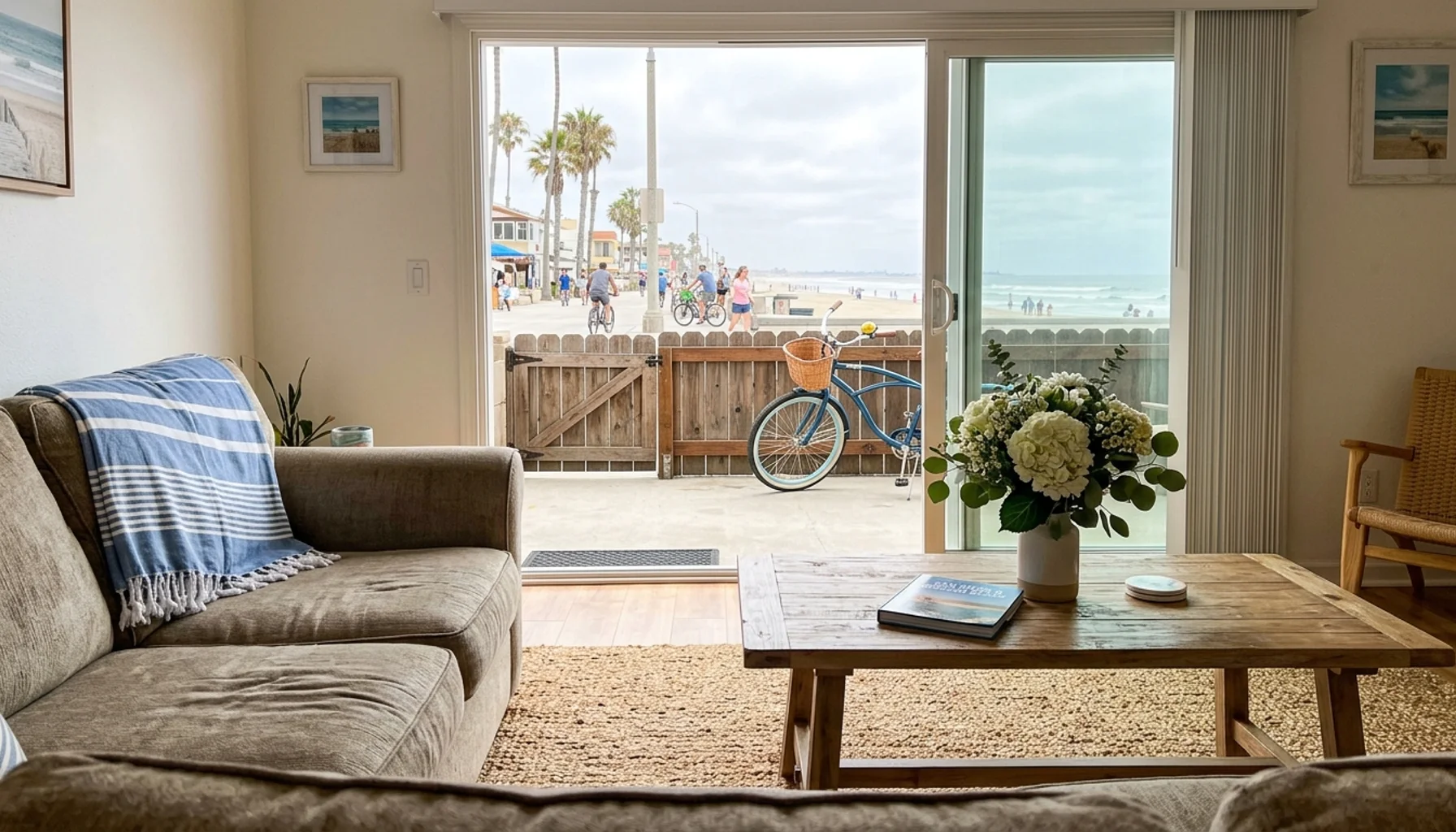
Lead with what guests will actually experience: a Mission Beach stay, described honestly.
Writing a vacation rental listing description means leading with your property's strongest differentiator, describing the stay instead of the inventory, and disclosing limits before guests discover them. At West Coast Homestays, we apply that formula across 80+ managed properties in Mission Beach, Pacific Beach, La Jolla, and North County San Diego. Here is how to write a listing description step by step in 2026.
Key Takeaways
Major booking platforms' host guidance splits listing information into the property, guest access, interaction with guests, and other details to note, so your description should never repeat what the amenity and house rule fields already say.
A common industry framework for description length is a 50 to 100 word overview, a 200 to 300 word detail section, and a 30 to 50 word close.
Verify every measurable claim (walking time, Wi-Fi speed, parking, stairs) before you publish it, because a mismatch between copy and reality shows up in your reviews.
Mission Beach whole-home rentals fall under the City of San Diego's Tier 4 STRO category, which carries a two-night minimum stay, so your copy cannot invite one-night bookings.
A weak description is only one of several reasons a listing underperforms; price, photos, and availability need to be ruled out first.
Your description is the one piece of your listing you control completely. Price moves with the market, photos depend on the property, and search rank depends on the platform's system. The words are yours. In Mission Beach, where a boardwalk cottage and a bayside condo compete in entirely different comp sets, generic copy leaves both underselling what makes them different.
This guide is for first-time hosts, burned-out self-managers, and out-of-state owners who wrote their description once, on launch weekend, and never touched it again. You will get a build sequence, sample openings for beach rentals, a length framework, and a way to tell whether your copy or something else is the real problem.
One caution up front: most published advice on this topic is qualitative. No public study we know of isolates a description structure as the cause of more bookings, so treat any promised conversion lift with skepticism. What follows draws on booking platforms' own host guidance and on what we see when we edit descriptions across our portfolio.
What Is the Correct Way to Write a Listing Description?
A listing description is the free-text section where you explain the stay in your own words, separate from the title, photos, amenity checkboxes, and house rules. The correct way to write one is to treat it as a structured answer to four guest questions: what will the stay feel like, who is it built for, what is nearby, and what should I know before I book. Major platforms' host resource centers organize host-written information into the property, guest access, interaction with guests, and other details to note.
That structure matters because each part has a different job. For example, platform examples show the tone: a modest downtown room becomes “a perfect base for exploring the city,” and a top-floor apartment surrounded by trees is described as feeling like a treehouse. Both examples sell an experience the guest can picture instead of listing square footage.
Guest access is the section owners skip most often. A typical example disclosure is simple: the patio is shared with the main house. As a result, one sentence like that prevents the 1-star review that begins with “we did not know.”
What Makes a Listing Description Effective for Guests?
An effective listing description lets a guest picture the stay and find no unpleasant surprises at check-in. Its effect shows up in indirect signals: fewer pre-booking questions, reviews that echo your wording, and guests who arrive with accurate expectations about parking, stairs, and noise.
Four qualities separate strong copy from filler:
Specificity: “Steps from the sand” means nothing until you say how many minutes on foot.
Candor: naming a quirk, such as a steep staircase or a shared wall, builds more trust than hiding it.
Guest focus: describe what a morning and an evening look like, not what you paid for.
Scannability: short paragraphs and selective bullets beat a single wall of text on a phone.
Skip the conversion-rate promises you see in template packs. Without a transparent methodology, a claim like “this format lifts bookings 30%” is marketing, not evidence.
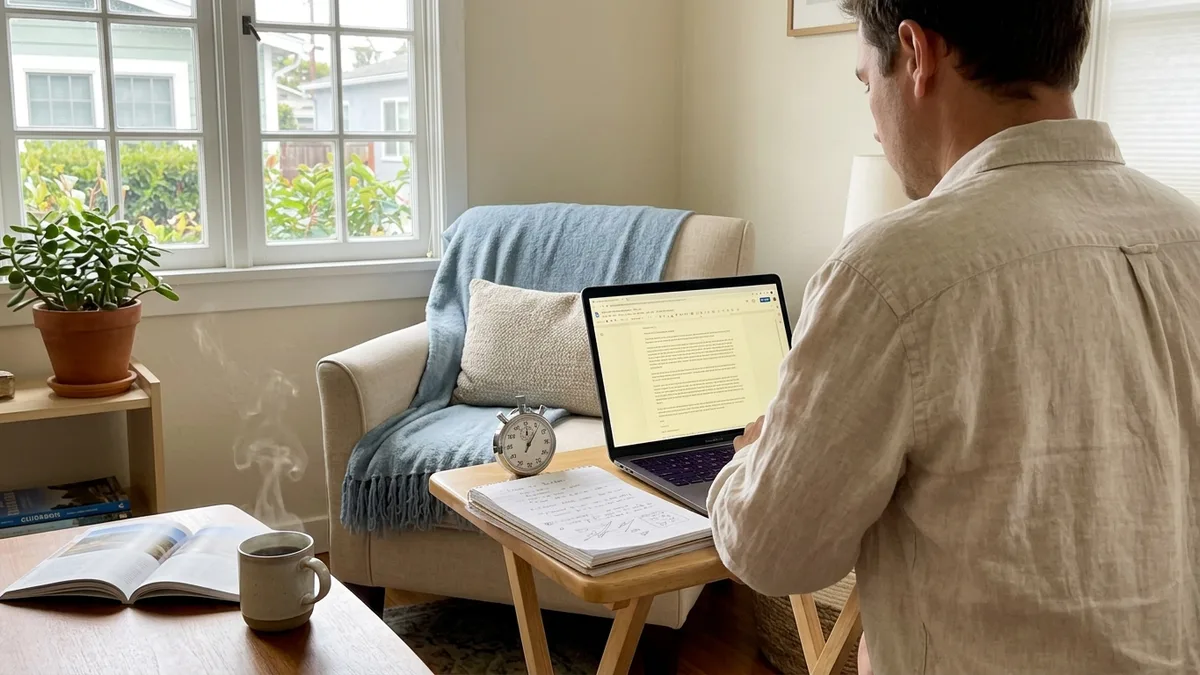
How to write a listing description for a Mission Beach rental
How to Write a Listing Description Step by Step
Writing a listing description is a sequence of eight tasks: verify facts, lead with a differentiator, describe the stay, write for guest types, add location detail, disclose limits, close warmly, and preview on the live listing. Timing depends on the property, and we have no verified benchmark for how long each step takes. Checking facts on site is usually the slowest part, because it means walking routes and testing Wi-Fi in person.
Step 1: Gather and verify your facts
Start with a fact sheet, not prose. Walk the route from the front door to the boardwalk or bay with a stopwatch. Run a speed test at the spot where a remote worker would sit. Confirm what parking your guests actually get. Most competing guides skip this step, and it is where descriptions go wrong.
At West Coast Homestays, we audit every claim before it goes live, because a guest who arrives to a ten-minute walk instead of the promised three writes that number into the review. Pull guest messages and past reviews for the questions people keep asking.
Step 2: Lead with your strongest differentiator
Put the single most compelling, true detail in your first two sentences. For a Mission Beach boardwalk cottage, that might be the walk to the sand. For a bayside condo, it might be the west-facing view over Mission Bay. Platform guidance advises keeping titles short and free of emojis, symbols, and all caps; a typical example, “Modern loft overlooking downtown,” uses four descriptive words.
Advice to front-load your opening is common, but no universal character limit applies across devices. Preview behavior varies, so check how your live listing displays on a phone and a laptop.
Step 3: Describe the stay, not the inventory
“Two bedrooms, one bath, granite counters” belongs in the property fields. In the description, write what the space enables: coffee on the patio before the boardwalk fills up, or a second bedroom with a door that closes for a nap. Every sentence should give the guest a picture or a decision-relevant fact.
Step 4: Write for your likely guest types
Writing for likely guest types means emphasizing the features that matter to each group without excluding anyone. Couples, families, remote workers, and small groups look for different things in the same property, so one description can speak to several of them at once.
For example, mention the dedicated desk and reliable Wi-Fi for remote workers, or the outdoor rinse-off spot for beach families. Importantly, describe what the property offers and let guests self-select. Never phrase copy in a way that restricts who may book.
Step 5: Add location detail guests can verify
Verifiable location detail means naming specific anchors and giving measured distances instead of vague claims. In Mission Beach, the boardwalk, Mission Bay, and Belmont Park each attract a different guest, so name the anchor that fits your property and state the walking time you measured.
Also say where guests can get groceries. In contrast, phrases like “close to everything” give guests nothing to check. The same principle applies a few blocks north in Pacific Beach; our Pacific Beach Airbnb management team sees owners win by naming specific streets and landmarks.
Step 6: Disclose limits and match the rules
Name the stairs, the shared patio, the summer noise near the boardwalk, and the parking situation. Then check that your copy fits the law. The City of San Diego requires a Short-Term Residential Occupancy (STRO) license for stays under one month, and operating without one has been unlawful since May 1, 2023. Mission Beach whole-home rentals fall under Tier 4, capped at 30% of Mission Beach dwelling units. Tier 3 and Tier 4 whole-home licenses require a two-night minimum stay and at least 90 days of annual use as a short-term rental.
Confirm your tier and current requirements on the City of San Diego STRO official page, and use the Community Planning Area map to see whether your property sits in the Mission Beach area.
Step 7: Close warmly and invite questions
A warm close is one or two sentences that give a practical note and invite guests to message you before booking. Its job is to leave the guest feeling looked after, not sold to.
For example, platform guidance uses an off-grid rural property with spotty cell service as a detail worth stating, along with a suggestion to print directions before arrival. As a result, a close that mentions where to find directions reads as care rather than a sales line, and it invites the questions that prevent surprises at check-in.
Step 8: Preview, publish, and log the edit
Read the live listing on a phone first, since most guests browse there. Then record the date and what you changed. That log becomes essential later, when you need to work out whether an edit helped or whether something else moved.
How Long Should a Listing Description Be?
A listing description should be long enough to answer a guest's booking questions and short enough to scan on a phone. Industry guidance commonly suggests a 50 to 100 word overview, a 200 to 300 word detail section, and a 30 to 50 word conclusion, which adds up to roughly 280 to 450 words in total. Booking platforms themselves emphasize concise, truthful copy over hitting a word target.
- Job
- Overview: Differentiator and best-fit guest
- Detail: Layout, sleeping setup, what a day looks like
- Neighborhood: Verified walking times and nearby anchors
- Close: Practical note and invitation to message
- Overview: 50 to 100 words
- Detail: 200 to 300 words
- Neighborhood: One or two short paragraphs
- Close: 30 to 50 words
Treat these ranges as starting points. For example, a studio near the boardwalk needs fewer words than a five-bedroom house that sleeps a group, where sleeping arrangements and house logistics take more space.
What Are Some Good Examples of Listing Descriptions?
A good listing description example opens with a verified differentiator, describes the experience in concrete terms, and states one honest limit. The samples below are illustrative openings for a fictional cottage and condo, not copy from a specific verified property. Swap in your own measured walking times, parking details, and Wi-Fi speeds before you publish anything similar.
Boardwalk cottage opening:
Coffee on the patio, then a short walk to the Mission Beach boardwalk. This two-bedroom cottage keeps your beach gear by the door, and the second bedroom has a real door for anyone who naps after a morning in the sand. Street parking near the boardwalk is limited in summer, so we include one dedicated space behind the cottage.
Bayside condo opening:
Sunset over Mission Bay from the living room, with a flat walk to the bayfront path. The second-floor unit is reached by one flight of stairs and has a dedicated desk by the window and Wi-Fi we tested for video calls.
Winter version for the same cottage:
The quiet season on the boardwalk: a wall heater for cool evenings, long walks at sunset, and a table that works for a laptop or a board game.
Each sample follows the same logic without sharing the same wording. The opening earns the click, the middle answers a decision question, and the limit builds trust. Seasonality is worth its own version because San Diego demand swings sharply between summer and winter, and guests looking in January want different reassurance than guests looking in July.
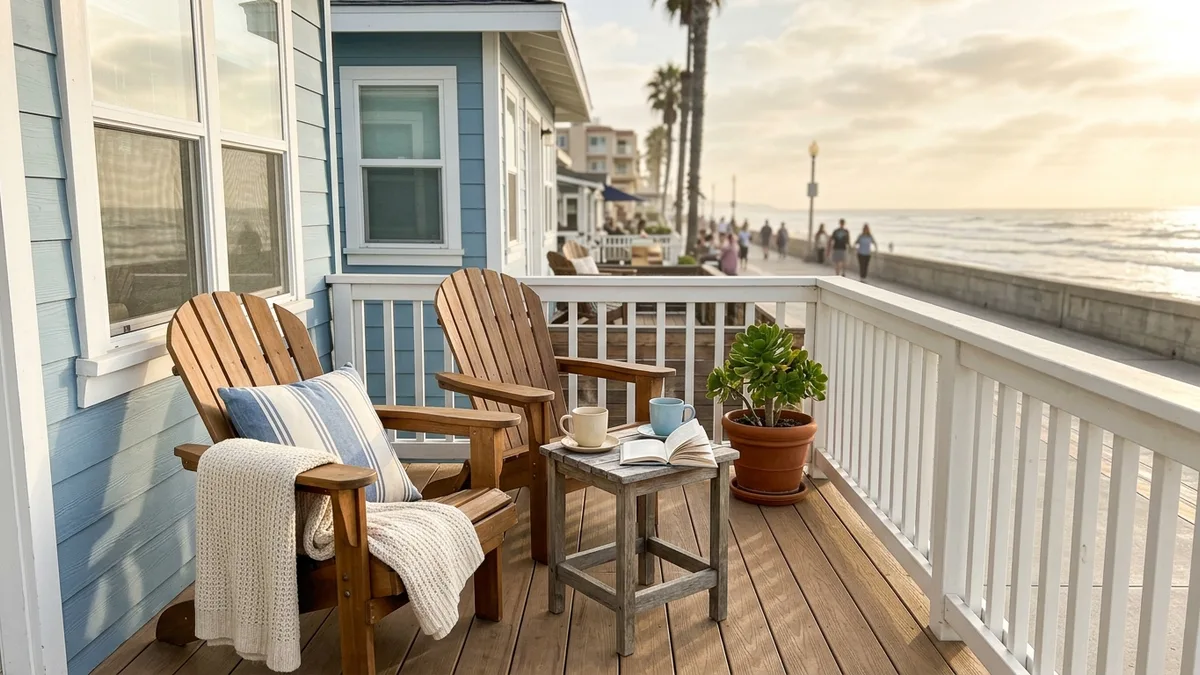
A bright Mission Beach boardwalk cottage patio with two chairs, a small table with coffee cups, and the ocean visible in soft golden light
How Do You Know Whether Your Description Is the Problem?
A copy problem is a listing that earns views and clicks but few inquiries or bookings, while a price, photo, or availability problem shows up at a different point in the guest's path. Diagnosing the right cause before rewriting saves you from editing words that were never the bottleneck.
- Likely cause
- Few views: Price, availability, or minimum-stay settings
- Views but few clicks: Title or lead photo
- Clicks but few bookings: Description gaps or price above comps
- Bookings but weak reviews: Expectation mismatch
- Same guest question repeated: Missing information
- Few views: Review your calendar and rate against comparable listings
- Views but few clicks: Shorten the title; lead with the strongest photo
- Clicks but few bookings: Add the details guests ask about; recheck pricing
- Bookings but weak reviews: Compare review complaints with your copy and rewrite the gap
- Same guest question repeated: Answer it in the description itself
Change one variable at a time and wait through a full booking window before judging the result. If pricing is the suspect, read up on how dynamic pricing lifts San Diego rental revenue.
Your reviews are free copywriting research. Read your own guests' phrasing and borrow their words for what they loved.
What Does Mission Beach Market Data Say About Listing Performance?
Mission Beach market data describes how short-term rentals in one of San Diego's premium coastal neighborhoods perform on occupancy, average daily rate, and annual revenue. The figures below show why precise copy pays off in a market where guests have many choices. They come from different sources and geographies (citywide San Diego, Mission Beach, and Encinitas), so compare them directionally, not line by line.
- Figure
- San Diego citywide STR (occupancy, ADR, revenue per active listing): 61%, $336, about $38,600
- Mission Beach STR estimate: 72% occupancy, $387.50 ADR, about $101,790 gross
- Mission Beach alternate snapshot: 36% median occupancy, $581 median nightly, $67,810 median revenue
- San Diego seasonal occupancy: 75% to 93% in June to August; 44% in January
- Dynamic pricing effect across 541 listings: 36.3% average gross revenue increase per unit
- Encinitas average daily rate: $507
- San Diego citywide STR (occupancy, ADR, revenue per active listing): AirDNA benchmark, June 2026
- Mission Beach STR estimate: 2026 market estimate
- Mission Beach alternate snapshot: BNBCalc listing data, 2026
- San Diego seasonal occupancy: Market sources cited for 2026
- Dynamic pricing effect across 541 listings: Your.Rentals and PriceLabs, 2026
- Encinitas average daily rate: RedAwning, 2026
Two Mission Beach snapshots disagree sharply on occupancy, which is normal when sources filter listings differently. Use them as a range and build your own comp set. Visitor demand supports the market: San Diego County reported 32.4 million visitors in 2026, and nearly 78% of visitor spending went to businesses other than lodging, which gives your neighborhood section real material to work with. For a North County comparison, see our Encinitas Airbnb guide for 2026.
The pricing study is a reminder of proportion. Pricing moved revenue by double digits across hundreds of listings, so if your rate is off, no rewritten paragraph will fix it. West Coast Homestays also sees the review side of the equation: in our data, 5-star reviews correlate with roughly 20% more revenue, and accurate descriptions are one of the cheapest ways to protect that rating.
How Does West Coast Homestays Approach Listing Optimization?
Listing optimization is the process of improving a listing's title, description, photos, pricing, and settings so that more of the guests who see it choose to book it. At West Coast Homestays, the description is one part of that work, written after we verify property facts and before we begin testing.
Our sequence starts with measured facts and a review of the comp set. We write the copy in the neighborhood's real vocabulary, then watch guest questions and reviews for gaps. Compared with owner-written copy or generic template output, this approach catches the details that matter locally, such as summer parking, boardwalk noise, and STRO rules. Our owners' results come from combining copy with pricing and revenue management, which is why we report $121K+ in added revenue from dynamic pricing plus listing optimization together.
Hybrid strategies need their own copy. A San Diego operator running a hybrid short-term and mid-term strategy reached $136,732 in annual revenue at 83.29% occupancy, against a $98,800 STR-only projection. A listing that welcomes 30-day stays speaks to a different guest than a weekend beach listing. If you want the full picture beyond copy, our overview of full-service Airbnb management in San Diego covers how the pieces connect, and our piece on building an Airbnb brand in San Diego shows how consistent voice carries across listings.
Which Description Mistakes Cost San Diego Hosts Bookings?
Description mistakes are avoidable copy errors that raise guest questions, lower trust, or create expectation gaps. These are the ones we see most often:
Repeating the amenity list and house rules that already appear in dedicated fields.
Writing vague hype, such as “perfect location” or “close to everything,” with no measured detail behind it.
Using emojis, symbols, or all caps in the title, which platform guidance advises against.
Hiding stairs, shared spaces, or parking limits, then paying for it in reviews.
Copying one description across a short-term listing and a mid-term listing.
Inviting one-night stays in a Tier 3 or Tier 4 area that requires a two-night minimum.
Never revisiting the copy after the first season of guest feedback.
Fixing even two of these often removes more friction than a full rewrite. Start with the disclosures, since those protect your rating.
What Are the Steps at a Glance?
Use this ordered list as a quick reference when you draft or audit a description.
Gather and verify facts: measure walking times, test Wi-Fi, confirm parking and access.
Lead with your strongest true differentiator in the first two sentences.
Describe the stay and the experience instead of listing inventory.
Write for likely guest types by emphasizing relevant features without restricting who can book.
Add location detail with named anchors and measured distances.
Disclose limits and confirm the copy matches STRO rules and your minimum stay.
Close with a practical note and an invitation to message you.
Preview on the live listing, publish, and log the edit to test its effect.
Conclusion: Write for the Guest You Want to Keep
Knowing how to write a listing description comes down to accuracy and specificity: verify your facts, lead with a real differentiator, describe the stay, and state your limits plainly. In Mission Beach and across San Diego's coastal neighborhoods, that discipline protects your reviews as much as it earns clicks. Before you rewrite, rule out price, photos, and availability, then change one thing at a time and log it. As 2026 unfolds, guests will keep comparing more listings faster, and the descriptions that answer their questions first will win the shortlist.
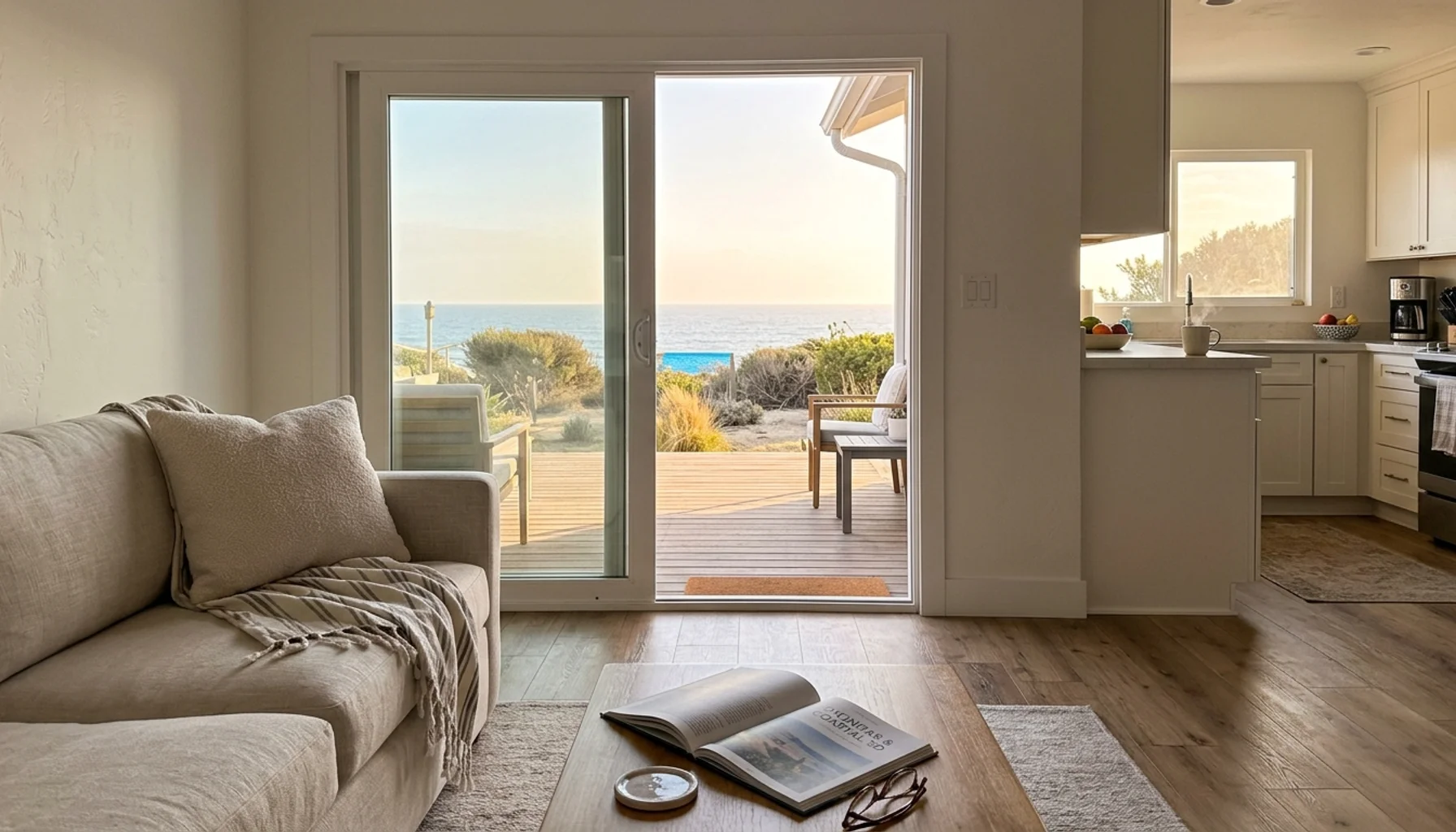
A guest's-eye view of an Encinitas beachfront rental: the setting behind those headline ADR numbers.
A listing that is not converting views into bookings is a fixable problem. West Coast Homestays handles listing optimization for owners across San Diego, backed by 80+ properties under management and a $121K+ revenue increase from dynamic pricing plus listing optimization. Book a call and we will walk through your specific numbers, or explore more guides on the Airbnb management blog.
Frequently Asked Questions
What details should a listing description include?
Include your strongest differentiator, what the stay feels like, the sleeping layout, verified location details, and any limits such as stairs, shared spaces, or parking. Leave out amenity lists and house rules that already have dedicated fields.
How long should a listing description be?
A common industry framework uses an overview, a detail section, a neighborhood section, and a short close, which adds up to a few hundred words. Booking platforms favor concise, truthful copy, so let the property's complexity set the length and check how it previews on the live listing.
How can a property manager improve my listing copy?
A manager can verify property facts, benchmark your listing against comparable properties, and rewrite the copy using guest questions and review language. West Coast Homestays also tests edits one at a time so you can tell copy changes apart from price or photo changes.
How much does it cost to have a professional handle my listing?
Industry benchmarks put full-service short-term rental management at roughly 15% to 30% of gross booking revenue, depending on the service level. Fees vary by property and scope, so confirm current terms directly with West Coast Homestays.
Does San Diego law affect what I write in my description?
Yes. The City of San Diego requires a STRO license for stays under one month, and Tier 3 and Tier 4 whole-home licenses require a two-night minimum. Your copy should never advertise stays the license does not allow, and you should verify current rules on the city's official STRO page.
Should I use emojis or all caps in my listing title?
No. Platform guidance advises keeping titles short and avoiding emojis, symbols, and all caps. A few precise descriptive words, such as “Modern loft overlooking downtown,” work better than decoration.
How often should I update my description?
Revisit it after each season and whenever guests ask the same question twice. Log the date and the change so you can connect edits to results.


