
Cost-Plus Pricing for Airbnb Hosts: Set a Rate Floor

Know your cost per bookable night before you set a rate floor.
Cost-plus pricing is a method that sets your Airbnb nightly rate by totaling every cost of hosting a night and then adding a markup percentage on top. At West Coast Homestays, we use it in Pacific Beach, CA as a rate floor: the number below which a booked night loses money, never the number you should charge.
Key Takeaways
Cost-plus pricing follows the formula (total cost per bookable night) x (1 + markup percentage) = nightly rate, so it protects you from underpricing but ignores what guests will pay.
Fixed expenses must be divided by nights you can realistically book, not 365; a Pacific Beach STR averaged roughly 164 booked nights (45% occupancy) in the twelve months ending May 2026.
A 25% markup on cost produces a 20% profit margin; a true 25% margin requires dividing cost by 0.75 instead.
Cleaning fees, minimum stays, platform fees, and taxes belong in the model, but each is easier to handle when you separate it from the nightly rate.
A 2026 study of 541 Airbnb listings found dynamic pricing lifted gross revenue per unit by 36.3% on average, so treat your cost-plus number as a floor, then price above it using market data.
Most hosts either copy a neighbor's rate or let an algorithm decide. Both skip the question that matters first: what does one booked night actually cost you? In 2026, with San Diego's STR market averaging around 60% occupancy per AirDNA, a rate that ignores your real costs can look busy on the calendar and still lose money.
From managing 80+ properties across San Diego's coastal neighborhoods, we see the same pattern in owner audits: strong-looking occupancy sitting on top of a nightly rate that never accounted for supplies or wear, or for the nights the house sits empty. This guide walks through nine practical steps to build a cost-plus rate, then shows where it breaks and what to layer on top.
1. What Is Cost-Plus Pricing, With an Airbnb Example?
Cost-plus pricing, also called markup pricing, is a strategy that sets a price by adding a fixed percentage to the total cost of delivering a product or service. Wall Street Prep states it as selling price = total cost per unit x (1 + markup percentage). For an Airbnb, the "unit" is one booked night.
Here is an illustrative Pacific Beach example (these figures are hypothetical, not client or market data, so swap in your own statements). Say your fixed costs are $24,000 a year and you expect 164 booked nights. That is $146.34 of fixed cost per night. Add $20 of variable cost per night for utilities and supplies, and your cost is $166.34. A 25% markup gives $207.93.
Notice what happens next to the roughly $206 average daily rate reported for a typical Pacific Beach STR. Your cost-plus number lands right at the market average, which tells you how little room exists when costs are high and nights are few.
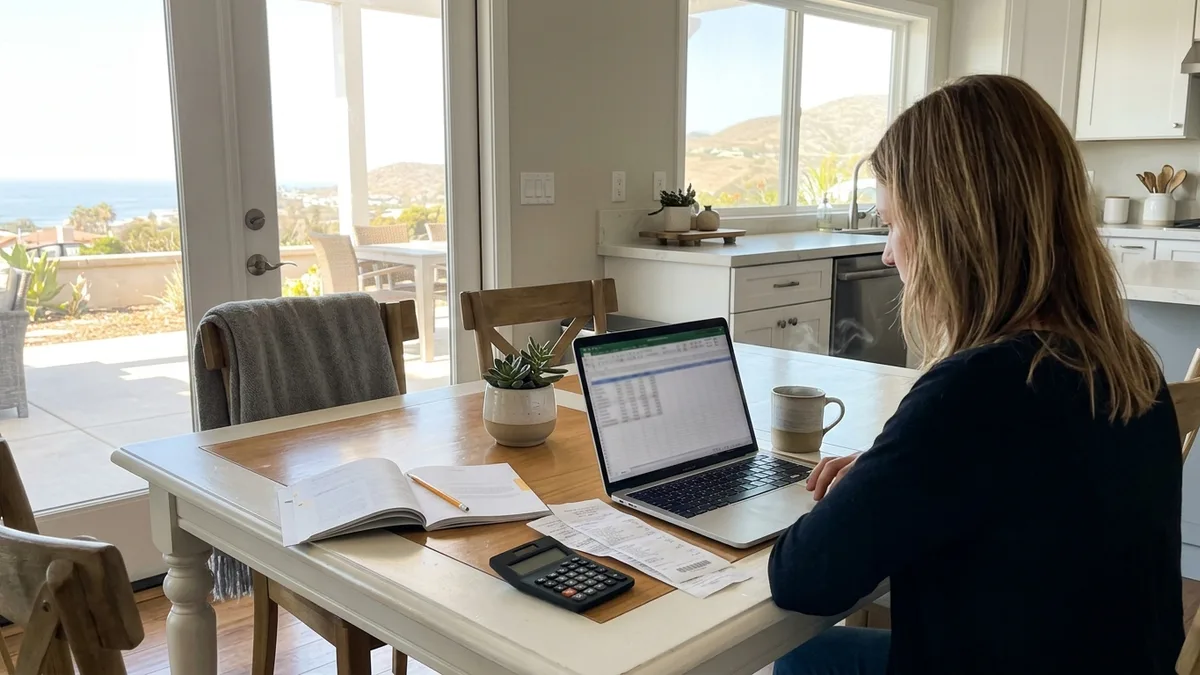
A host at a sunlit coastal San Diego kitchen table with a laptop spreadsheet, calculator, and printed expense receipts, late morning light
2. Which Costs Belong in Your Per-Night Floor?
A per-night cost floor is the sum of every expense a booked night must cover before you earn a dollar of profit. Most hosts remember the mortgage and cleaner, then forget the smaller items that add up across a year.
Fixed costs include insurance, property taxes, HOA dues, internet, software subscriptions, and your STRO license. The City of San Diego publishes current license requirements on its STRO official page, so confirm fees there rather than relying on old figures. Variable costs include utilities, toiletries, linens, and wear on furniture. Beach properties add salt-air corrosion on patio furniture and sand in the laundry, so budget for faster replacement than an inland home needs.
Add management fees if you hire help. According to Mavericks TR (2026), STR property management typically costs 15% to 30% of gross nightly revenue, and the exact percentage varies by property and service level. Separately, San Diego Cash Buyer's 2026 analysis put total annual operating costs for a typical 3-bedroom Pacific Beach STR between $41,239 and $68,925. Your own number should come from your statements, not an average.
What is Cost-Plus Pricing Strategy? From A Business Professor
3. How Do You Spread Fixed Costs Across Bookable Nights?
Bookable-night allocation means dividing your annual fixed costs by the nights you can realistically sell, not by 365. This is the step most generic cost-plus guides skip, because factories rarely sit empty on a Tuesday in November.
Pacific Beach demand is strongly seasonal, with June through August as the peak and June and July the busiest months. A property earning about 45% occupancy books roughly 164 nights, so each booked night must carry the cost of the 200-odd nights that stay empty. Dividing by 365 would understate your floor by more than half. Winter weekdays along Garnet Avenue and the boardwalk are the nights that stay empty most often, so plan around them.
Add all fixed costs for the year.
Subtract nights you will block for owner stays or repairs.
Multiply remaining nights by a conservative occupancy estimate.
Divide fixed costs by that booked-night count.
Add variable cost per night.
Use your lowest realistic occupancy, not your best summer. If you beat it, the difference is profit.
4. Why Is a 25% Markup Not a 25% Profit Margin?
Markup is profit as a percentage of cost, while margin is profit as a percentage of the selling price. Umbrex explains the distinction: markup = (price minus cost) divided by cost, and margin = (price minus cost) divided by price.
Using the earlier example, a $166.34 cost with a 25% markup gives a $207.93 rate. Profit is $41.59, which is only 20% of $207.93. To earn a true 25% margin, divide cost by (1 minus 0.25): $166.34 / 0.75 = $221.79. That is a $13.86 difference on every booked night.
- Calculation
- 25% markup on cost: $166.34 x 1.25
- 25% target margin: $166.34 / 0.75
- 25% markup on cost: $207.93
- 25% target margin: $221.79
Illustrative figures only. Choose one method and stay with it, so your reports compare cleanly month to month.
5. Should Cleaning Fees Sit Outside the Nightly Rate?
A cleaning fee is a one-time, per-booking charge that recovers the cost of turning the property over between guests. It belongs outside your nightly rate in most cost-plus models, because cleaning cost is driven by the number of bookings, not the number of nights.
Here is why that matters. A two-night stay and a seven-night stay cost the same to clean. If you bury cleaning inside the nightly rate, short stays lose money and long stays overpay. Minimum stays change the math in the same way: a three-night minimum spreads one turnover across more revenue, which is a common lever during summer weekends in Pacific Beach and Mission Beach.
In our experience, cleaning fee optimization alone produced $6,600 a year in added profit for one managed property, and early check-in and late checkout upsells have generated $5,500 to $6,500 a year. Both are per-booking line items that a flat nightly cost-plus model would miss.
6. When Should You Use Cost-Plus Pricing?
Cost-plus pricing works best when you need a defensible minimum, when market data is thin, or when you are deciding whether a property can profit at all. It answers "can this house make money?" far better than "what should I charge this weekend?"
Use it in three situations: evaluating a purchase or lease, setting a floor for dynamic pricing software, and pricing a mid-term rental where stays run 30 days or more and demand swings matter less. For mid-term pricing, cost-plus is more reliable because fewer turnovers and steadier occupancy make your cost estimates tighter.
One San Diego operator we work with ran a hybrid short-term and mid-term strategy and reached $136,732 in annual revenue at 83.29% occupancy, against a $98,800 STR-only projection. The mid-term nights were priced from a cost floor first; the short-term nights were priced from demand. If you are weighing a similar structure, our Airbnb management in San Diego team can model both.

A bright modern coastal vacation rental living room with a tablet on the coffee table showing a pricing calendar, warm afternoon light
7. What Is a Disadvantage of Cost-Plus Pricing?
The main disadvantage of cost-plus pricing is that it ignores what customers will pay and what competitors charge. Your costs do not change when a major event fills San Diego hotels, and they do not shrink when three new listings appear on your block.
That blind spot cuts both ways. In peak summer weeks, a cost-based rate leaves money on the table because guests would pay far more. In slow January stretches, the same rate can sit unbooked because it sits above what the market will bear. Pure cost-plus also rewards inefficiency: higher costs push your rate higher, which is the opposite of what the market does.
Static pricing during summer weekends is one of the most common ways Pacific Beach hosts lose revenue. Dynamic pricing errors cut the other direction: we have seen miscalibrated pricing cost an owner $30,000 to $40,000 in a single month. A cost floor guards against underpricing, but it cannot find the ceiling.
8. How Do You Pair a Cost Floor With Local Market Rates?
Pairing a cost floor with market rates means using cost-plus pricing as the minimum and comparable listings, events, and seasonality to price above it. Your floor protects the downside; the market sets the upside.
A 2026 study of 541 Airbnb listings across 34 countries (reported by Your.Rentals and PriceLabs) found dynamic pricing raised gross revenue per unit by 36.3% and nights booked by 37.3%, while ADR slipped 0.7%. The lesson: volume and timing drive the gains, not higher base rates. Airbnb's own help center explains how to turn Smart Pricing on or off, and our walkthrough of dynamic pricing strategy for rentals covers the tool side.
A Pacific Beach cottage and a La Jolla oceanview condo compete in different comp sets, so treating them the same is a frequent mistake. West Coast Homestays pairs a cost floor for each property with active compset tracking, then adjusts for events and seasons. Our guide to mastering dynamic pricing for San Diego rentals shows the same logic on Vrbo.
9. Who Uses Cost-Plus Pricing, and How Do Property Managers Price Their Services?
Cost-plus pricing is common in construction and contract manufacturing, and in any business where costs are measurable and customers expect itemized quotes. Markt-Pilot's construction example takes a $1 million project cost, adds a 20% markup, and arrives at a $1.2 million price. Government contractors and custom-fabrication shops use the same logic because the buyer can audit every line.
Property management companies mostly price differently. Instead of cost plus markup, they typically charge a percentage of gross booking revenue, which aligns the manager's income with yours. That is why STR management fees commonly land between 15% and 30% depending on scope. A manager who earns a share of revenue has a reason to push your occupancy and rate up, while a manager billing cost plus markup earns more when your expenses rise. Fees vary by property, so confirm any quote directly with the manager.
When you ask for a quote in Pacific Beach, request an itemized list covering the management percentage, cleaning, supplies, maintenance markup, and any onboarding charges. Ask whether linens and restocking are billed at cost or with a markup, since that line is where fees most often drift. Our San Diego property management cost guide explains what to compare, and the Pacific Beach Airbnb management page covers what we handle locally.
Is Cost-Plus Pricing Enough to Set Your Airbnb Rate?
Cost-plus pricing is enough to tell you whether a property can profit, and it gives you a defensible floor, but it is not enough to set your daily rate. Build the floor from bookable nights, choose markup or margin on purpose, then price above it using demand data throughout 2026 and beyond.
Owners who skip the floor risk selling nights below cost; owners who stop at the floor leave summer revenue behind. Our clients' dynamic pricing and listing work has produced $121K+ in revenue increases, and the hybrid model has delivered 39% to 66% above compset revenue.

a split-screen showing a vacation rental pricing dashboard with real-time rate adjustments
If you want to see where your nightly rate sits against your true costs, West Coast Homestays offers revenue management and dynamic pricing for 80+ properties across Pacific Beach, La Jolla, Mission Beach, Encinitas, Carlsbad, and Oceanside. You can book a call and we will review your numbers with you.
Frequently Asked Questions
How much does Airbnb management cost?
According to Mavericks TR (2026), short-term rental property management typically costs 15% to 30% of gross nightly revenue. The exact percentage depends on the services included, such as pricing, cleaning coordination, and guest communication. Confirm the current fee structure directly with West Coast Homestays or any manager you consider.
How do I set pricing for my rental in San Diego?
Start with your cost floor: annual fixed costs divided by realistic booked nights, plus variable cost per night. Then compare similar listings in your neighborhood and adjust for season and local events. Pacific Beach and La Jolla rarely share a comp set, so benchmark within your own area.
What is the difference between markup and margin?
Markup is profit divided by cost, while margin is profit divided by selling price. A 25% markup on a $166.34 cost yields a 20% margin, while a 25% margin requires a rate of $221.79 (illustrative figures). Pick one method and use it consistently.
How do you calculate cost-plus pricing for services?
Add all fixed and variable costs of delivering the service, divide by the number of units you expect to sell, and multiply by (1 + markup percentage). For a rental, the unit is a booked night. Handle per-booking costs like cleaning as a separate fee.
Should I use cost-plus pricing or dynamic pricing?
Use both. Cost-plus gives you a minimum rate that protects profit, and dynamic pricing raises rates when demand rises. A 2026 study of 541 listings showed dynamic pricing lifted gross revenue per unit by 36.3% on average.
Who can help me price a Pacific Beach short-term rental?
West Coast Homestays provides revenue management and dynamic pricing for short-term and mid-term rentals across Pacific Beach and other San Diego coastal neighborhoods, and it manages 80+ properties. When comparing providers, ask for itemized fees, a compset-based pricing method, and examples of results tied to specific properties.


