
Best App for Landlords in San Diego: 7 Apps Compared 2026
Managing a few San Diego units? The right landlord app depends on your unit count.
The best app for landlords depends on your unit count: Landlord Studio's free plan covers three units, TurboTenant is described as a free all-in-one option, and AppFolio targets large portfolios. At West Coast Homestays, we manage 80+ properties across San Diego's coastal neighborhoods and see exactly where these apps save you a weekend and where they stop short. This guide compares seven of them for San Diego owners in 2026.
Key Takeaways
No single app wins every category. Roundups match apps to a use case: Landlord Studio for tracking rental income, TurboTenant as a free all-in-one, Avail for independent landlords, and AppFolio for large portfolios.
Landlord Studio is free for three units, and its paid plan starts at $12 per month for up to three units, according to published comparison pages. Confirm current pricing before you commit.
San Diego County apartment vacancy reached 6.2% at the end of June 2026, with average asking rent of $2,583 per month (CoStar data reported by The San Diego Union-Tribune), so screening and fast turnover matter more now.
Landlord apps are built for long-term leases. Short-term rentals also need dynamic pricing, multi-channel calendars, guest messaging, and City of San Diego permit compliance.
Test data export before you enter a single lease. Few roundups cover what happens when you switch platforms.
Landlord apps are phone and browser tools that collect rent, track expenses, and route repair requests so you can stop running a rental from a spreadsheet and a text thread. They matter more in San Diego this year than they did a few years ago. CoStar data reported by The San Diego Union-Tribune puts county apartment vacancy at 6.2% at the end of June 2026, with average asking rent of $2,583 per month.
The market is uneven. Downtown vacancy was nearly 12%, while coastal submarkets such as Del Mar, Encinitas, Solana Beach, and La Jolla ran near 3%. Higher vacancy means more screening, more listings, and more turnover, and each of those lands on your weekend if you manage by hand.
Below you will find seven apps, a pricing snapshot, a portfolio-size guide, California compliance checkpoints, and a plan for switching apps without losing records. We built the comparison from published roundups by DoorLoop, Landlord Studio, Stessa, and Baselane, plus what we see operating rentals daily. We did not run hands-on tests of every app, and vendors describe their own products, so verify each claim in a free trial.
What Makes the Best App for Landlords in 2026?
Rental property management software is a set of tools that handles rent collection, tenant screening, maintenance requests, and bookkeeping from one login. For San Diego landlords in 2026, the features worth paying for are the ones that remove recurring weekend work.
Rent collection: online payments with automatic reminders and late fees, a core function in Landlord Studio's roundup.
Tenant screening: Landlord Studio runs screening through TransUnion. Confirm any provider's permissible-use rules before you pull a report.
Listing syndication: one posting pushed to major rental sites, useful when vacancy is climbing.
Bank-feed accounting: automatic reconciliation of income and expenses, plus a Schedule E report at tax time.
Maintenance requests: a tenant-side form and a contractor-side handoff.
Exports and permissions: downloadable ledgers, and limits on what a bookkeeper or assistant can see.
If you own one or two units, bank feeds and rent reminders return the most time. Maintenance workflows start paying off once you own more than one roof and tenants text you at 9 p.m.
What Is the Best Property Management Software for Small Landlords?
The best property management software for small landlords is the app that matches your unit count and your most expensive recurring task, whether that is collecting rent or screening applicants. Here are seven to shortlist, each with a best-fit use, a price note, and a caveat.
1. Landlord Studio: Best for Income and Expense Tracking
DoorLoop's roundup names Landlord Studio best for tracking rental income. Its own page describes bank feeds that reconcile income and expenses, online rent collection with reminders and late fees, TransUnion screening, listing syndication, and a Schedule E report in a couple of taps. It is free for three units, with paid plans from $12 per month for up to three units. Caveat: confirm pricing once you pass three units. It suits an owner with a house and a rented ADU.
2. Stessa: Best for Financial Dashboards
Stessa's roundup describes automated accounting and real-time dashboards, with tenant screening and rent collection also listed. If you want to see net income across properties without building a spreadsheet, start here. Caveat: our sources do not publish its fee structure, so ask who pays for rent collection and screening before you onboard tenants.
3. TurboTenant: Best Free All-in-One
DoorLoop's roundup calls TurboTenant a free all-in-one property management app, and Jotform's roundup points to it, along with Innago, when budget is the priority. Caveat: check whether screening and payment fees fall on you or the applicant before you call any app free. For a one-rental owner who dislikes subscriptions, this is the first trial to run.
4. Avail: Best for Independent Landlords
DoorLoop's roundup identifies Avail as an app for independent landlords. We found fewer published specifics for Avail than for the others, so we cannot vouch for its feature depth. If you shortlist it, request a demo and walk through rent collection and screening yourself before paying. Until you have done that, TurboTenant is the safer pick in the same size range.
5. DoorLoop: Best Overall, by Its Own Ranking
DoorLoop's roundup names DoorLoop its best overall property management app. A vendor ranking itself 1st is marketing, so treat it as a reason to trial the app, not proof it wins. It belongs on the shortlist of owners with a growing portfolio who want one platform for operations and accounting.
6. Rentec Direct: Best for Customization
DoorLoop's roundup labels Rentec Direct best for customizable property management. Customization helps if your portfolio mixes unusual setups, such as long-term leases and furnished 30-day stays. Caveat: more settings mean more setup time, so budget an evening or two before your first rent cycle.
7. AppFolio: Best for Large Portfolios
DoorLoop's roundup describes AppFolio as built for streamlining operations across large portfolios. That scale is its strength and its drawback: a landlord with two or three units will probably pay for depth they never open. Property Matrix, labeled enterprise-level in the same roundup, sits above it.
Also worth knowing: Rentmoji is pitched for simple rent tracking and automation, and Jotform notes that TenantCloud offers line-item permission controls for team access while its automation tools are more limited.
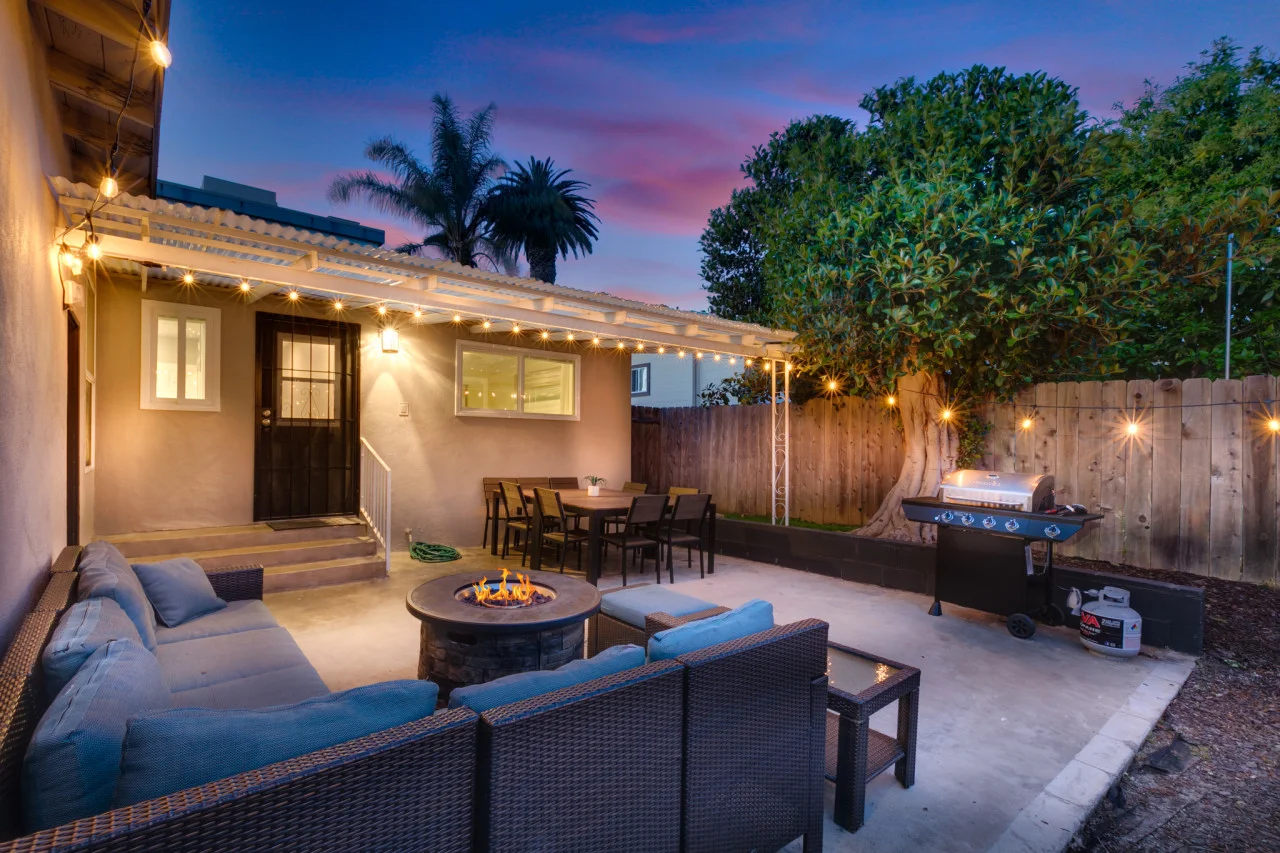
A beautifully illuminated backyard patio space at twilight featuring a fire pit surrounded by comfortable seating, a dining area, and a built-in grill against a wooden fence with mature landscaping and palm trees.
What Is the Best Free Software for Landlords?
Free landlord software is any app whose base plan costs nothing, usually capped by unit count, feature set, or who pays transaction fees. The table below shows only what our sources verify; every blank is a question for the vendor.
- Free or entry option
- Landlord Studio: Free for three units; paid plan from $12 per month for up to three units
- TurboTenant: Described as a free all-in-one app (DoorLoop roundup)
- Innago: Recommended by Jotform when budget is the priority
- Stessa: Not quoted in our sources
- DoorLoop, AppFolio, Rentec Direct, Avail: Pricing varies by plan and unit count
- Landlord Studio: Pricing beyond three units
- TurboTenant: Who pays screening and payment fees
- Innago: Current plan limits
- Stessa: Plan tiers and rent-collection fees
- DoorLoop, AppFolio, Rentec Direct, Avail: Written quote for your unit count
For free accounting, start with Landlord Studio's three-unit plan or Stessa's accounting-focused platform, then confirm which features sit behind paid tiers. Our real estate accounting articles cover what to track once your books grow.
Is AppFolio Worth It, or Do You Need a Smaller App?
AppFolio is a property management platform that DoorLoop's roundup describes as built for streamlining operations across large portfolios. Whether it is worth the cost depends on how many units you run, and most roundups sort apps by category without saying so plainly. This table is our starting point, not a vendor ranking.
- Shortlist
- 1 to 3 units: Landlord Studio, TurboTenant
- 4 to 15 units: Stessa, Avail, Rentec Direct
- 16 or more units: DoorLoop, AppFolio, Property Matrix
- 1 to 3 units: Free or low-cost entry points with rent collection and bookkeeping
- 4 to 15 units: Dashboards, independent-landlord focus, and customization
- 16 or more units: Operations built for scale; demand a demo using your own data
Across the properties we manage at West Coast Homestays, the friction usually appears when a second or third property adds another lease, another bank account, and another set of contractors. That is the moment to leave a free tier. A landlord with 50 rentals should demo at least two large-portfolio platforms and ask each how it handles owner reporting and permissions.
What Is the 2% Rule for Rentals, and Does It Work in San Diego?
The 2% rule is an investor screening heuristic that says a rental's monthly rent should equal at least 2% of its purchase price. It is a quick filter, not a measure of profit.
Run it against San Diego numbers. With countywide average asking rent at $2,583 per month, a property would need to cost roughly $129,000 to pass. San Diego purchase prices run well above that, so almost nothing here clears the bar. Treat the rule as a filter for other markets. A tracking app such as Stessa, with its real-time dashboards, gives you actual income and expenses for the properties you own, which is more useful than a heuristic.
Which Landlord Apps Support California Compliance?
California landlord compliance means following state and local rules on rent increases, deposits, notices, tenant screening, and permits. None of the sources we reviewed publish a California-specific compliance feature set, so the app will not read the law for you.
California's AB 1482 caps annual rent increases at 5% plus local CPI, with a 10% maximum, for eligible multi-family properties over 15 years old. Just-cause eviction rules can also apply to tenants with 12 or more months of continuous occupancy. Check whether your property qualifies before you automate any rent increase.
Look for configurable late-fee rules, deposit tracking, dated message logs, and exportable notices. Fair Housing Act obligations apply to every screening decision, regardless of the app. The California Department of Real Estate requires a broker license, or work under a licensed broker, to manage property for compensation.
Short-term rentals add a layer a landlord app does not touch. The City of San Diego publishes rules on its short-term residential occupancy page, and you should confirm current license requirements there.
Which App Features Give You Your Weekends Back?
Weekend-saving features are the recurring tasks an app automates so they stop arriving as Saturday interruptions. None of the roundups we reviewed quantify minutes saved, so test these workflows during a one-month trial:
Rent reminders and late fees: automatic reminders turn the chase on the 1st into a notification.
Repair requests: check that a tenant can submit from a phone and that a contractor can respond without creating an account.
Document access: leases, insurance papers, and inspection reports in one place, which matters most if you own from out of state.
Bank-feed bookkeeping: reconcile weekly instead of dumping a shoebox of receipts on a Sunday in March.
Screening and listing syndication: weekday leasing work that otherwise eats weekend showings.
Count how many tasks reach you by text after the first month. If it is more than a handful, the app is not doing its job.

A stunning modern architectural exterior showcasing a contemporary white two-story house with sleek lines, expansive glass doors, and a resort-style backyard featuring an illuminated rectangular swimming pool, wooden deck, and palm trees at twilight.
Where Do Landlord Apps Stop and Professional Management Begin?
Landlord apps are built around the long-term lease cycle: one monthly rent payment, an annual renewal, and occasional repairs. Short-term rentals run on nightly pricing, same-day turnovers, and guest messages that arrive at midnight, which a rent-collection app was not designed to handle.
Pricing shows the gap most clearly. AirROI reports that top-10% Airbnb properties in San Diego achieve $12,946 or more in monthly revenue in 2026, and the distance between an average listing and that benchmark comes from calibration, not software alone. Dynamic pricing errors can cost $30,000 to $40,000 in a single month; we have seen it happen and corrected it.
Location changes the job too. Pricing a boardwalk cottage in Pacific Beach like a condo is a common mistake. A La Jolla oceanview condo competes in an entirely different comp set. In Encinitas, AirROI reports that best-in-class Airbnb properties in the top 10% reach 85% or higher occupancy, and that is a pricing and listing outcome, not an app setting.
Mid-term stays of 30 days or more sit between the two worlds. A landlord app can handle rent and bookkeeping for them, but placement and pricing still need market data. One San Diego operator running a hybrid STR and MTR strategy reached $136,732 in annual revenue at 83.29% occupancy, against a $98,800 STR-only projection.
West Coast Homestays handles listing optimization, revenue management, 24/7 guest communication, cleaning and turnover, and channel management as one accountable team, which is the work behind full-service Airbnb management in San Diego. If you are weighing cost, our San Diego property management cost guide explains what owners typically pay; fees vary by property, so confirm directly.
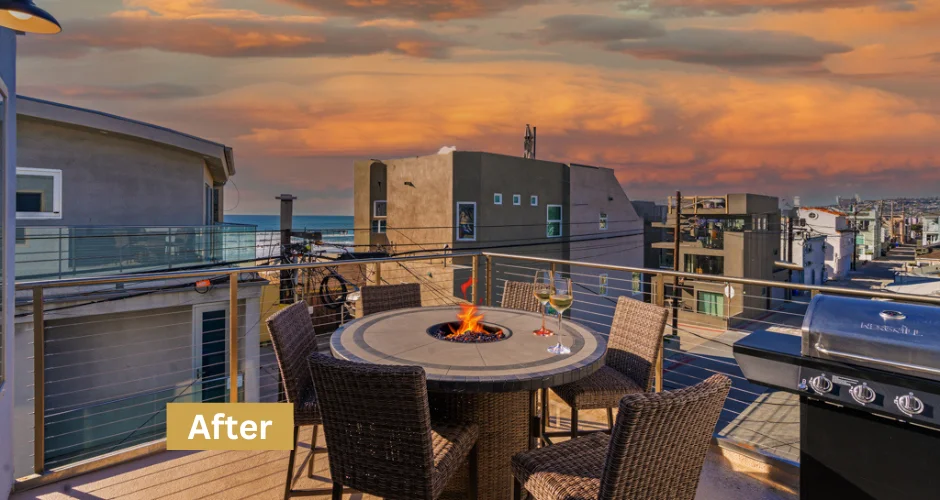
A stunning rooftop patio at sunset featuring a round fire pit table surrounded by woven chairs, with a built-in grill and panoramic city skyline views beneath a golden and orange sky.
How Do You Choose an App and Move Your Records Over?
Choosing a landlord app is a five-step process that starts with your unit count and ends with a tested data export. Follow these steps in order:
Count your units and name the one task that costs you the most time.
Pick two apps from the portfolio table above and start both trials.
Ask each vendor whether you can export tenants, ledgers, and documents. Test the export before you enter real data.
Put one phone-comfortable tenant and one contractor through the tenant-side and contractor-side flows.
Connect your bank account, reconcile one month, and save a copy of the export to your own cloud storage each quarter.
The common mistakes are paying for enterprise features you never open and ignoring how tenants experience the app. Mixing personal spending into the rental bank account is another. Switching later is far easier when your ledger lives in a clean, exportable format.
Frequently Asked Questions
What are the best neighborhoods in San Diego for rental properties?
CoStar data reported by The San Diego Union-Tribune showed vacancy near 3% in Del Mar, Encinitas, Solana Beach, and La Jolla at the end of June 2026, versus nearly 12% Downtown. The best fit depends on strategy: long-term, mid-term, or nightly. Our Carlsbad rental management team can walk through North County numbers.
What is the best free accounting software for real estate businesses?
Start with Landlord Studio, which is free for three units, or Stessa, which is built around automated accounting and real-time dashboards. Confirm which features sit behind paid tiers, since free plans are usually capped by unit count.
What rental property accounting software works for landlords with 50 rentals?
At that size, shortlist large-portfolio platforms such as AppFolio, DoorLoop, and Property Matrix, which roundups position for bigger operations. Demo each with your own data and check owner reporting, team permissions, and export options before signing.
Is AppFolio worth it for a small landlord?
Usually not. DoorLoop's roundup positions AppFolio for large portfolios, so a one- to three-unit owner will likely pay for features they never use. Landlord Studio or TurboTenant fit that size better.
What is the best site to list a short-term rental in San Diego?
West Coast Homestays manages San Diego short-term and mid-term listings across Airbnb and other booking channels, since multi-platform distribution across Airbnb, VRBO, Booking.com, and direct booking is becoming the minimum standard for professional STR management. Before you list anywhere, confirm City of San Diego license requirements. Owners near the coast can review our Oceanside market page.
Can a landlord app replace a property manager?
For a long-term lease, an app can replace much of the paperwork. For short-term rentals, it cannot set nightly rates, answer guests, or coordinate same-day turnovers, so owners typically add a manager or a full-service team.
Which App Should You Pick in 2026?
The best app for landlords in San Diego comes down to unit count, who pays the fees, and whether you can export your data. Start with Landlord Studio or TurboTenant for one to three units, trial Stessa or Rentec Direct as you grow, and demo AppFolio or DoorLoop at scale. Apps keep getting better at rent, books, and repairs, but nightly pricing and guest care still need people. Expect that split to hold through 2026 and beyond.


