
Mission Beach Airbnb Regulations: Myths vs. Facts (2026)
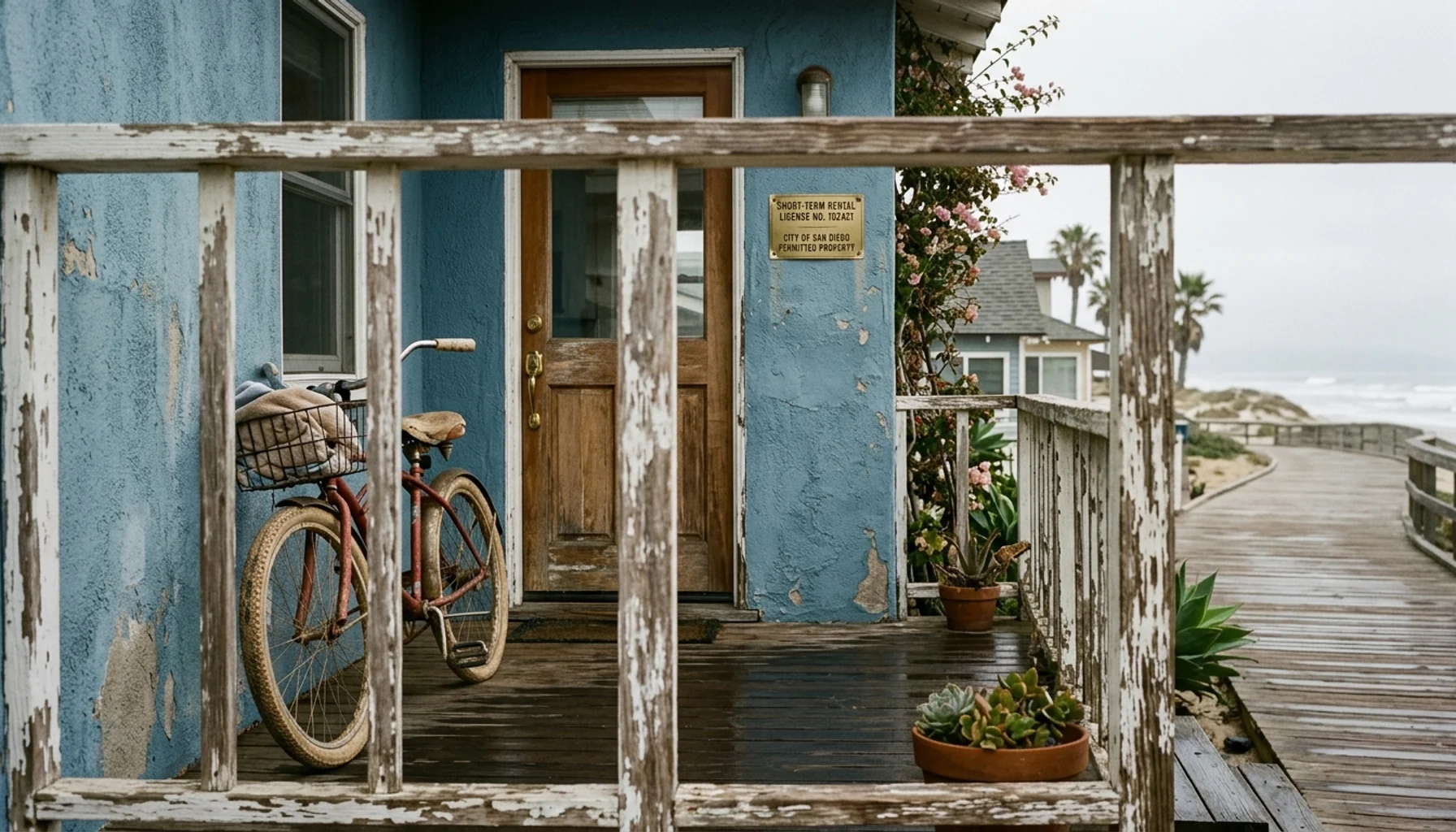
A licensed short-term rental in Mission Beach, where Tier 4 permits are capped and non-transferable.
Airbnb regulations in Mission Beach are governed by the City of San Diego's Short-Term Residential Occupancy (STRO) Ordinance, and as of 2026 the Tier 4 license category that covers most Mission Beach whole-home rentals has zero licenses remaining. That single fact upends most of what hosts assume about entering this market. At West Coast Homestays, we manage short-term and mid-term rentals across San Diego's coastal neighborhoods, including Mission Beach, Pacific Beach, and La Jolla, and the misconceptions we hear from new owners about Mission Beach compliance are remarkably consistent. This guide corrects the most persistent myths with the actual ordinance language and current license data.
Key Takeaways
Mission Beach whole-home rentals fall under Tier 4 of San Diego's STRO Ordinance, capped at roughly 30% of the neighborhood's housing stock, or about 1,080 properties.
As of the city's most recent published count, 1,099 Tier 4 licenses have been issued with 0 remaining, and the waitlist that reopened in mid-2025 has since closed again.
Operating an unlicensed short-term rental in San Diego has been unlawful since May 1, 2023; violators face fines and platform delisting.
Tier 4 license fees total $1,170 ($41 application plus $1,129 license), and licenses expire two years after issuance and cannot be transferred between owners or properties.
Mission Beach STRs generate strong returns when licensed correctly. Reported occupancy has ranged from 73% to 93% depending on season, according to RedAwning data.
Mid-term rentals of 30 nights or longer do not require an STRO license at all, giving locked-out buyers a legal path to rental income in Mission Beach.
Mission Beach is the smallest and most tightly regulated rental market in the City of San Diego, and it is also one of the most misunderstood. New buyers frequently assume the rules mirror Pacific Beach or La Jolla, or that a closed waitlist means they simply need to wait a few months. Neither is accurate.
In 2026, the gap between what property owners believe about Mission Beach short-term rental rules and what the San Diego Municipal Code actually requires has real financial consequences. A buyer who purchases a Mission Beach property expecting to list it on Airbnb within weeks can find themselves holding an unlicensed asset with no legal path to short-term rental income for years.
This article walks through the specific myths we encounter most often from owners and investors evaluating Mission Beach, and pairs each one with what San Diego's STRO Ordinance and the city's licensing data actually say. We also cover enforcement mechanics, HOA interaction, and the mid-term rental alternative.
Myth: Mission Beach Airbnb Regulations Are the Same as the Rest of San Diego
This is false. Mission Beach operates under its own license category, Tier 4, which does not exist anywhere else in the city. Pacific Beach, La Jolla, and Ocean Beach fall under Tier 1, 2, or 3 of the STRO Ordinance instead.
Tier 3 covers whole-home rentals outside Mission Beach and allows the host to be absent up to 90 days a year, with a citywide cap near 1% of total housing units. Tier 4, by contrast, applies only within the Mission Beach Community Planning Area and is capped at approximately 30% of that neighborhood's dwelling units, or roughly 1,080 properties.
Mission Beach has the highest concentration of licensed short-term rentals of any San Diego neighborhood, a status confirmed by city data cited in NBC 7 San Diego's coverage of the ordinance. Tier 4 also requires a two-night minimum stay, a rule that does not apply to Tier 3 properties elsewhere in the city. If you're comparing a Pacific Beach condo to a Mission Beach cottage, treat them as entirely separate regulatory environments, not variations on the same rule set.
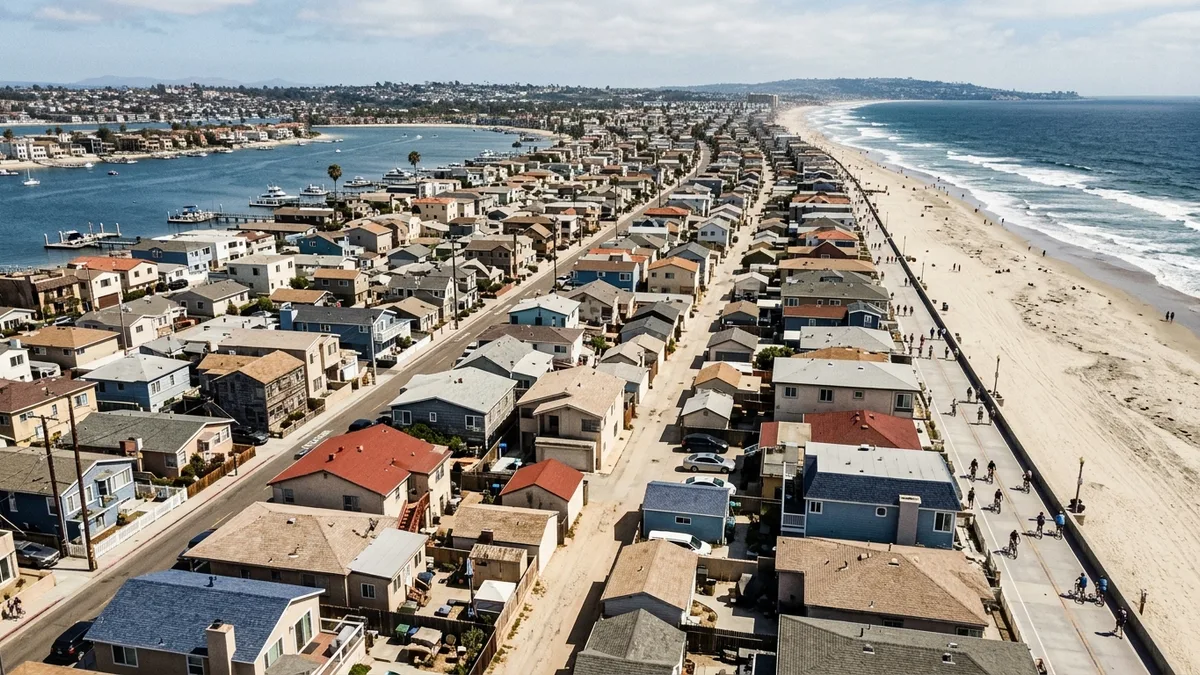
An aerial view of Mission Beach California showing dense rows of small beach cottages packed close together near the boardwalk and ocean
Myth: You Can Still Apply for a New Mission Beach Airbnb License in 2026
This is currently false for most applicants. The Tier 4 license category reached its cap, and as of the most recent published city data, 1,099 licenses have been issued with 0 remaining. The city briefly reopened a Tier 4 waitlist window from June 29 to August 15, 2026, but that window was limited to existing license holders and has since closed again.
Tier 4 applications opened after the California Coastal Commission certified the program in fall 2022, then closed once the cap was reached in 2023. The 2026 reopening was not a general application period; it was a narrow, time-limited exception. As of 2026, there is no active general application path for a new Tier 4 license in Mission Beach.
Waitlist positions, when the program does reopen, are assigned by random lottery and prioritize applicants with a clean compliance history. Hosts with pending enforcement actions are disqualified from consideration entirely. If you are evaluating a Mission Beach purchase specifically for short-term rental income, confirm current license availability directly through the City of San Diego STRO official page before assuming a license is obtainable, and check the Active STRO Licenses Open Data Portal for the property's specific licensing history.
Myth: Buying a Property With an Existing License Means You Can Just Take It Over
This is false, and it is one of the most expensive mistakes we see buyers make. San Diego's STRO Ordinance states that licenses are non-transferable between hosts, properties, or ownership changes, under SDMC §510.0106(d). A Tier 4 license does not convey with the sale of a Mission Beach property.
A buyer purchasing a Mission Beach cottage that currently operates as a licensed short-term rental cannot continue operating it under the seller's license after closing. The new owner must apply independently, and because the Tier 4 cap has been reached, that application currently has no active path to approval.
A host may hold only one STRO license at a time, so an existing license holder cannot add a Mission Beach property to their portfolio without giving up another license first. If a real estate listing markets a Mission Beach property's "STR income potential," ask specifically whether the license transfers, and verify the answer against the full text of the STRO Ordinance rather than taking the listing agent's word for it.
What Are the New Airbnb Laws in California for 2026?
California does not currently regulate short-term rentals through a single statewide licensing law; regulation happens at the city and county level, which is why Mission Beach rules differ sharply from other California coastal towns. San Diego's STRO Ordinance, in effect since May 1, 2023, remains the controlling framework for Mission Beach, Pacific Beach, and the rest of the city in 2026.
What has changed heading into 2026 is enforcement intensity and tax administration. San Diego's Transient Occupancy Tax rates were updated effective May 1, 2026, and now sit at 11.75%, 12.75%, or 13.75% depending on the property's tax zone, with rates highest near the downtown tourist core. Mission Beach properties should confirm their exact zone using the city's TOT lookup tools rather than assuming a flat rate.
Separately, discussion around tightening Tier 3 restrictions citywide has continued, as reported by the San Diego Union-Tribune's coverage of proposed short-term rental law changes. No changes have been finalized specifically for Tier 4 as of 2026, but Mission Beach owners should treat the current cap and rules as subject to future adjustment rather than permanent.
What Are the Restrictions on Airbnb in San Diego More Broadly?
San Diego restricts short-term rentals through the four-tier STRO licensing system, mandatory tax registration, and a Good Neighbor Policy that applies to every tier. Understanding how these layers interact matters even for Mission Beach owners who already hold a license, since ongoing compliance is separate from initial approval.
The Four License Tiers
- Description
- Tier 1: Part-time rental
- Tier 2: Home sharing
- Tier 3: Whole home, outside Mission Beach
- Tier 4: Mission Beach whole home
- Tier 1: 20 days per year or fewer, no onsite residency required
- Tier 2: Host resides onsite, rentals over 20 days per year
- Tier 3: Host absent up to 90 days per year, citywide cap near 1% of housing units
- Tier 4: Rentals over 20 days per year, two-night minimum stay, host does not reside onsite
- Tier 1: 134 issued, unlimited remaining
- Tier 2: 2,353 issued, unlimited remaining
- Tier 3: 4,862 issued, 799 remaining
- Tier 4: 1,099 issued, 0 remaining
Ongoing Compliance Obligations
Every license holder, regardless of tier, must maintain an active Transient Occupancy Tax certificate and a paid Rental Unit Business Tax account. Tier 3 and Tier 4 holders carry an additional obligation: a minimum of 90 days of annual rental use to keep the license active, per SDMC §510.0107(c), plus quarterly reporting to the city that Tier 1 and Tier 2 hosts are exempt from.
Fines for operating without a required license or letting compliance lapse start around $1,000 per violation, and hosting platforms are required to remove unlicensed listings once notified. That obligation on platforms like Airbnb is spelled out in the Hosting Platform requirements (SDMC Ch.5 Art.10 Div.2), which also requires platforms to collect and remit TOT and retain transaction records for four years.
Myth: Once You Get a License, There's Nothing Left to Track
This is false, and it is where we see licensed Mission Beach hosts get flagged for enforcement most often. A Tier 4 license carries ongoing obligations that outlast the approval date: the license expires exactly two years after issuance, and renewal is not automatic.
The city emails renewal notices 60 days before expiration, but the burden sits with the host to act on them. Beyond renewal, Tier 4 hosts must file quarterly usage reports and maintain the 90-day minimum annual use threshold. The Good Neighbor Policy stays in effect at all times, not just during application review.
The Good Neighbor Policy requires displaying the STRO license number on the listing and physically at the property, enforcing quiet hours, and providing guests a copy of neighbor guidelines at check-in. It also requires designating a 24/7 local contact and equipping the unit with a smoke detector, a carbon monoxide detector, and a fire extinguisher. You can review the complete list in the STRO Good Neighbor Policy official PDF and cross-check ongoing obligations against the STRO Host Requirements Checklist.
How Does Enforcement Actually Work for Mission Beach Violations?
San Diego enforces STRO violations through a complaint-based system that starts with a public reporting tool and can escalate to fines, license revocation, or referral for code enforcement. The mechanics matter because a single unresolved complaint can jeopardize a Tier 4 license that took years to obtain.
Anyone, including a neighbor, can file a complaint directly through the city's Submit an STRO Violation Online portal. This is also the answer to a common question: can a neighbor stop an Airbnb next door? A neighbor cannot revoke a license unilaterally, but a documented pattern of Good Neighbor Policy violations, such as repeated noise complaints, can trigger city review and jeopardize renewal.
The city also cross-references properties against open code enforcement complaints during license review. You can check a specific address using the Check Code Enforcement Complaints Against Your Property tool before applying. Applicants with pending enforcement actions are automatically disqualified from the Tier 4 waitlist lottery when it reopens.
Should You Buy in Mission Beach for Short-Term Rental Income in 2026?
Buying in Mission Beach specifically for a new short-term rental license is a weak strategy in 2026, because the Tier 4 cap sits at 1,099 issued licenses with zero remaining and no active general application window. This is the calculation most listing agents skip when marketing "STR-ready" Mission Beach properties.
Realistically, a buyer has three paths. First, purchase a property with an existing, currently active Tier 4 license and negotiate the sale with full awareness that the license itself does not transfer and must be reapplied for once the program reopens, which is not guaranteed on any timeline. Second, buy the property and operate it as a mid-term rental of 30 nights or longer, which requires no STRO license at all. Third, wait for a future lottery reopening and accept the odds, since positions are randomly assigned and enforcement-clean applicants are prioritized.
From what we see across our managed portfolio, owners underuse the mid-term path because they assume Mission Beach only works as a short-term play. Mission Beach's premium coastal draw and dense vacation-rental infrastructure make it a strong mid-term market even without a Tier 4 license, particularly for insurance placement and relocation contracts. Owners weighing this decision may benefit from a data-backed comparison of San Diego exit strategies for short-term rental owners before assuming a purchase locks them into one model.
A small office desk with a laptop displaying a rental licensing website next to a printed San Diego neighborhood map and a coffee cup
Myth: HOAs in Mission Beach Can't Restrict What the City Already Allows
This is false, and it is a gap most Mission Beach guides skip entirely. Holding a valid Tier 4 STRO license does not override a homeowners association's own CC&Rs. San Diego's ordinance governs whether short-term rental activity is legal citywide; the HOA governs whether it is permitted within a specific condo building or community.
Mission Beach has a meaningful number of condo and duplex buildings with active HOAs. CC&Rs written before the 2023 STRO Ordinance sometimes predate any short-term rental restriction, while others were amended afterward specifically to ban rentals under a certain length. A property owner can hold a fully compliant Tier 4 license and still be in violation of their own building's governing documents. Because HOA rules vary building by building in Mission Beach and no single association name applies neighborhood-wide, you need to pull the specific building's documents rather than assume a neighborhood-standard rule exists.
Before purchasing or applying for a license, request the current CC&Rs and any rental-related amendments directly from the HOA board or management company, not just the seller's disclosure packet. This step is separate from and in addition to the STRO application prerequisites.
What Documents Do You Need Before You Even Apply?
Before submitting a Tier 4 application, and this applies once the waitlist reopens, hosts need three prerequisite items in place: an active Transient Occupancy Tax certificate, a paid Rental Unit Business Tax account, and proof of right to occupy the property.
Register for a TOT certificate through the Transient Occupancy Registration System, or verify an existing certificate number through the OpenData TOT lookup.
Confirm your Rental Unit Business Tax account is active using the OpenData Rental Unit Business Tax (RUBT) Account Lookup.
Gather proof of right to occupy: a lease clause, the owner's written statement, or a completed STRO Owner's Authorization Form if you are not the titled owner.
Confirm the property sits within San Diego's city jurisdiction, not an unincorporated area, using the City of San Diego Council District Map.
Verify the property's Community Planning Area to confirm Mission Beach Tier 4 rules apply, using the City of San Diego Community Planning Area (CPA) Map.
Check for open code enforcement complaints against the address before applying, since pending actions disqualify Tier 4 waitlist applicants.
Once documentation is confirmed, applications are submitted through the Accela portal, and the fee, $41 for the application plus $1,129 for the license itself, is non-refundable even if the applicant is not selected.
Myth: Mission Beach STRs Aren't Worth the Regulatory Hassle
This is false for licensed properties. Mission Beach consistently outperforms San Diego's citywide short-term rental averages on both occupancy and rate. According to RedAwning market data, Mission Beach vacation rentals have achieved occupancy between 73% and 93% depending on season and property type, well above the roughly 61% citywide occupancy AirDNA reported for San Diego overall in June 2026.
Rate performance follows a similar pattern, though the sources we track don't agree on one number. RedAwning-linked market snapshots put Mission Beach's average daily rate near $387.50 with roughly $101,790 in annual gross revenue per listing. Other data, including figures compiled from BNBCalc, cite a higher band closer to $544.80 ADR and $145,800 in annual revenue for premium coastal units near the boardwalk. Treat both figures as directional rather than a single expected number: the spread reflects how much property type and proximity to the boardwalk affect performance within Mission Beach itself, so a two-bedroom cottage two blocks off the sand and a beachfront unit on the boardwalk can land at opposite ends of that range.
What separates a top performer from an average one in Mission Beach usually isn't the license, it's the pricing strategy layered on top of it. This is exactly where dynamic pricing built around real compset data makes the difference between a licensed property that merely breaks even and one that captures Mission Beach's seasonal demand spikes, which run from roughly 75% to 93% occupancy in June through August against 44% in January.
Practical Guidance: What Mission Beach Owners Should Actually Do
Given the current Tier 4 cap, Mission Beach owners and buyers need a strategy that accounts for licensing scarcity rather than assuming a license is available on demand. The following approach reflects what we recommend to owners evaluating this specific neighborhood.
Verify license status before closing, not after. Use the Active STRO License Map to confirm a specific address's current licensing status rather than relying on a seller's representation.
Assume the license does not transfer. Structure your offer and financing around the property's value as a residence or mid-term rental first, with STR income as upside only if a future license is secured.
Check the HOA separately from the city license. A Tier 4 approval is worthless if the building's CC&Rs prohibit rentals under 30 days.
Consider mid-term rental as the default, not the fallback. Structuring a hybrid strategy around 30-plus night stays avoids the Tier 4 bottleneck entirely while still capturing Mission Beach's premium coastal demand.
Keep a clean compliance record. Any open code enforcement complaint disqualifies you from a future Tier 4 waitlist lottery, so resolve issues immediately rather than letting them linger.
Owners managing properties in nearby Pacific Beach or La Jolla often assume Mission Beach rules will eventually loosen to match those markets. Nothing in the current ordinance or city data supports that assumption for 2026.
Frequently Asked Questions
How much does Airbnb management cost for a Mission Beach property?
Full-service short-term rental management typically ranges from 15% to 30% of gross booking revenue, while co-hosting arrangements where the owner retains listing control usually run 10% to 18%. Exact rates depend on the property's size and condition and on whether services include design, revenue management, and guest communication, so confirm current pricing directly with a management company.
What are the rights of a co-host on Airbnb?
A co-host's rights and responsibilities are defined by Airbnb's official Co-Host Terms of Service, which outline access permissions, communication duties, and payout arrangements agreed to between the host and co-host. These terms govern platform-level permissions rather than local licensing, so a co-host arrangement does not change who is legally responsible for a property's Mission Beach STRO license.
How much does an Airbnb manager cost in San Diego?
San Diego short-term rental managers generally charge within the same 10% to 30% of gross revenue range seen nationally, with full-service firms toward the higher end because they bundle pricing, cleaning coordination, maintenance, and guest support. The specific figure varies by neighborhood, property type, and service scope, so request a written breakdown before signing any management agreement.
Should I choose a local San Diego Airbnb manager or a national company like Vacasa or Evolve?
Choose a local manager if you're buying in Mission Beach: national platforms manage at scale but with less local nuance, while a local San Diego manager typically has direct knowledge of neighborhood-specific rules like Mission Beach's Tier 4 cap, HOA nuances, and compset pricing patterns. In a regulatory environment as fragmented as San Diego's, where compliance rules differ meaningfully between Mission Beach, Pacific Beach, and La Jolla, local expertise on licensing and enforcement tends to matter more than it would in a less-regulated market.
Can I stop my neighbor from having an Airbnb in Mission Beach?
You cannot unilaterally revoke a neighbor's STRO license, but you can file a documented complaint through the city's STRO violation reporting portal if the property violates the Good Neighbor Policy, such as repeated noise issues or missing signage. A pattern of substantiated complaints can affect the host's compliance record and jeopardize future license renewal.
What are the restrictions on Airbnb in San Diego for someone without a Mission Beach license?
Without a Tier 4 license, a Mission Beach property cannot legally be rented for stays under 30 nights, regardless of how the listing is worded on Airbnb or Vrbo. The legal alternative is a mid-term rental of 30 nights or longer, which falls outside STRO licensing requirements entirely and remains available to any owner regardless of the Tier 4 cap status.
How much does Airbnb property management cost compared to self-managing?
Self-managing avoids the 10% to 30% management fee but shifts the cost into time spent on guest messaging, turnover coordination, and pricing adjustments, plus the risk of compliance mistakes in a heavily regulated market like Mission Beach. Professional management typically pays for itself through improved occupancy and reduced pricing errors, though the exact return depends on the property and how actively the owner would otherwise manage it.
Conclusion
Mission Beach's Airbnb regulations are the strictest and most saturated in the City of San Diego, with the Tier 4 license category sitting at 1,099 issued licenses and zero remaining as of the most recent city data. We corrected several myths here: Mission Beach rules do not mirror the rest of the city, a closed waitlist will not simply reopen soon, licenses do not transfer with a property sale, and HOA rules still matter once the city approves a license. Believing any of these leads to the same outcome: an owner who assumes short-term rental income that the property cannot legally generate.
The properties that perform well in Mission Beach in 2026 are the ones where owners verified licensing status before closing, understood the two-night minimum and compliance obligations that come with a Tier 4 license, and built a realistic fallback plan around mid-term rentals if a license was never obtainable. Mission Beach's occupancy and rate performance, among the strongest in San Diego County, still make it worth pursuing correctly.

A property manager reviewing a dynamic pricing dashboard on a laptop at a sunlit desk overlooking the San Diego coastline
If you're weighing a Mission Beach purchase, holding an existing Tier 4 license, or considering a mid-term strategy to work around the current cap, West Coast Homestays manages 80-plus properties across San Diego's coastal neighborhoods and can walk through your property's specific licensing status, HOA exposure, and revenue potential before you commit capital. Get started with West Coast Homestays to get a data-backed read on your Mission Beach property before you buy, list, or renew.


