
Airbnb Regulations Encinitas: 2026 Permit Guide
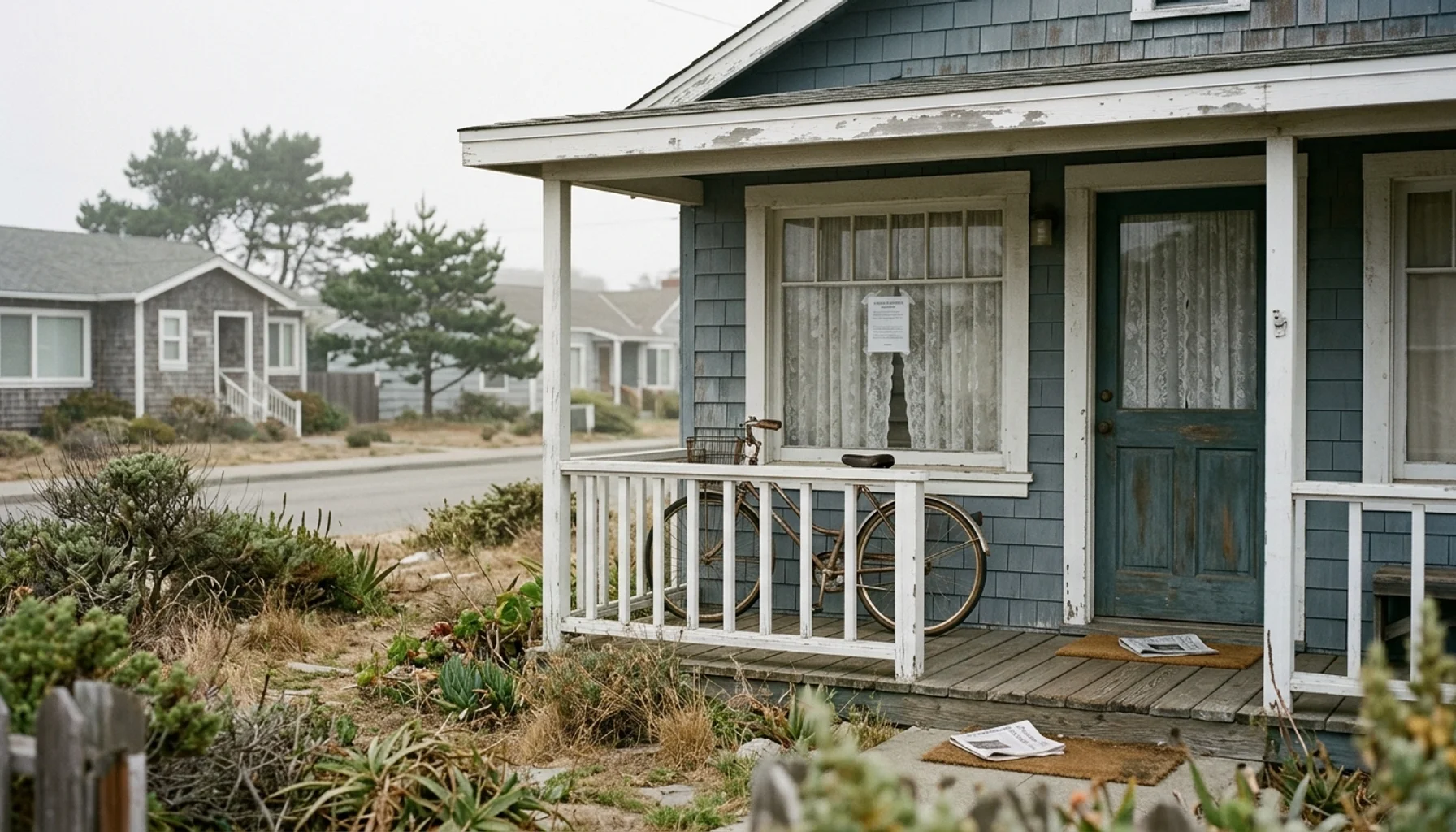
A permitted short-term rental in Encinitas, where city code requires posted registration before booking.
Airbnb regulations in Encinitas require every host to hold a valid short-term rental permit from the City of Encinitas, pay a $425 application or renewal fee, and collect a 10% Transient Occupancy Tax from guests before advertising a property on Airbnb or Vrbo. At West Coast Homestays, we've walked North County owners through this exact permit process across Encinitas, Carlsbad, and Solana Beach, and the biggest mistake we see is hosts advertising before their permit clears.
Key Takeaways
The City of Encinitas requires a short-term rental permit before you rent, offer to rent, or advertise a property for stays of 30 consecutive days or less, per Encinitas Municipal Code Chapter 9.38.
The permit application and annual renewal fee is $425, up from $150 before Resolution No. 2021-108 took effect on January 7, 2022.
Encinitas reported 443 permitted short-term rentals as of May 15, 2026, with 95.9% located inside the Coastal Zone.
Guests pay a 10% Transient Occupancy Tax on rent charged, with 2% of that tax dedicated specifically to beach sand replenishment and stabilization projects.
Non-hosted rentals face a citywide cap of 2.5% of housing units (4% in Cardiff-by-the-Sea, Leucadia, and Old Encinitas west of Interstate 5) and a 200-foot spacing rule west of I-5.
The California Coastal Commission approved Ordinance Nos. 2022-15 and 2022-16 on February 5, 2026, reducing the non-hosted minimum stay from three nights to two nights.
Encinitas sits in an unusual spot among San Diego County's coastal cities: it has one of the more detailed short-term rental ordinances in the region, with separate rules for hosted and non-hosted rentals, geographic caps tied to zip codes and freeway boundaries, and a permit system that has grown stricter, not looser, over the past several years. If you own a property here or you're considering buying one, understanding these Airbnb regulations in Encinitas isn't optional homework. It's the difference between a compliant rental generating steady income and a listing that gets shut down mid-season.
This guide walks through what qualifies as a short-term rental under Encinitas Municipal Code Chapter 9.38, how the permit application actually works, what the Transient Occupancy Tax obligation looks like in practice, and where the hosted-versus-non-hosted distinction changes your compliance requirements. We also cover a February 2026 update from the California Coastal Commission that most existing guides on this topic haven't caught up with yet.
As of 2026, Encinitas has roughly 731 active short-term rental listings tracked by AirDNA, though that supply figure has dropped 13.3% year over year through May 2026, likely a direct result of the city's permit caps and enforcement pressure. At West Coast Homestays, our team manages properties across Encinitas, Carlsbad, and Oceanside, and we treat permit compliance as the first item on every new owner's checklist, before pricing strategy, before listing photos, before anything else.
What Counts as a Short-Term Rental Under Encinitas Law?
A short-term rental in Encinitas is legally defined as a privately owned single-family home or duplex unit, or a portion of one, rented for dwelling, lodging, or sleeping purposes for 30 consecutive days or less, according to the City of Encinitas Code of Ordinances. Non-monetary compensation, such as a trade-for-stay arrangement, also qualifies under this definition. Specifically, the 30-day threshold is what separates a short-term rental from a standard lease.
Multi-family dwellings, including apartments and condominiums, are not eligible for short-term rental permits under current City guidance. Newly constructed accessory dwelling units (ADUs) are also excluded from short-term rental use in most cases. As a result, if you're evaluating a condo or a newly built ADU as a potential Airbnb investment in Encinitas, confirm eligibility with the city's Short-Term Rental Permits page before you close on the property.
Operating without a valid permit is classified as a misdemeanor under Chapter 9.38. This isn't a civil fine you can absorb as a cost of doing business; it's a criminal violation. Additionally, advertising a property, even before the first booking, triggers the permit requirement. Listing on Airbnb or Vrbo while your application is still pending is one of the most common compliance mistakes we see among new North County hosts.
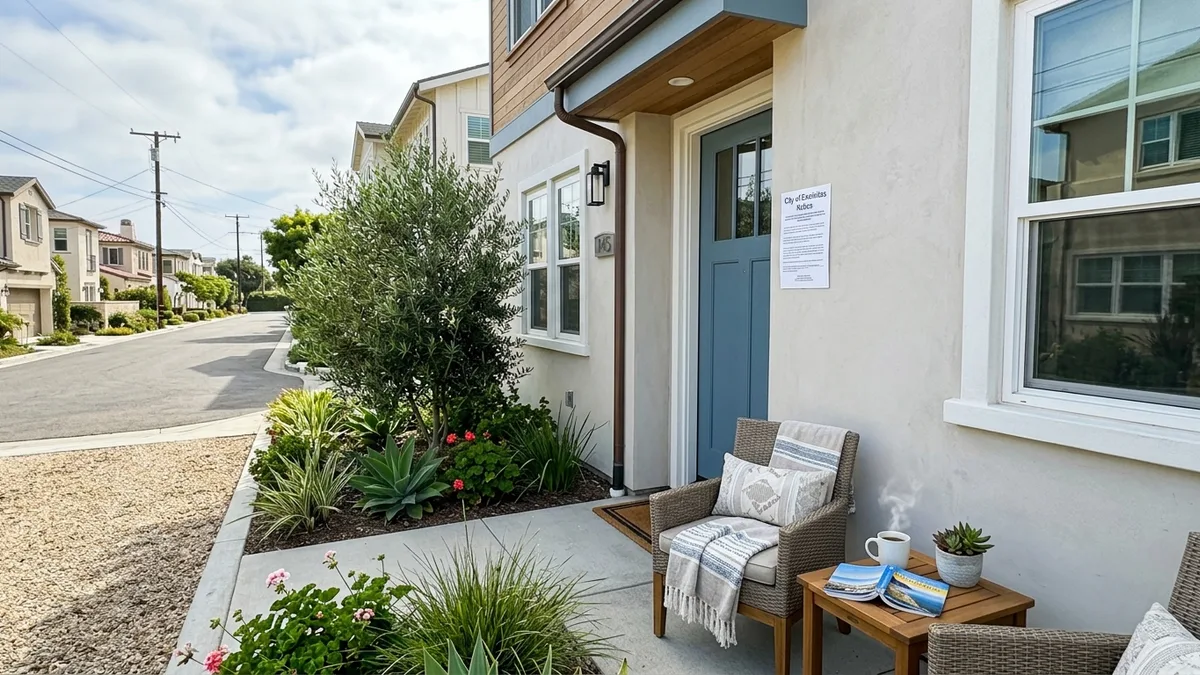
A coastal Encinitas home exterior with a visible official notice posted near the front door, morning light, quiet residential street
How Do You Get an Encinitas Short-Term Rental Permit?
Getting an Encinitas short-term rental permit means submitting a complete application through the city's online Customer Self Service portal, paying a $425 fee, and providing proof of ownership, a site plan, a floor plan, liability insurance, and business registration. The City states that a new Customer Self Service account is typically approved within 24 business hours of registration, which is faster than many California coastal cities process comparable applications.
First, create your account on the Customer Self Service (CSS) Portal. Once approved, gather your documentation:
Completed short-term rental application form
Proof of ownership or documented owner permission
A rental site plan showing the property address, assessor parcel number, zoning designation, property boundaries, adjacent road names, and the location, number, and dimensions of on-site parking spaces
A rental floor plan identifying which portion of the structure is proposed for short-term rental use
Liability insurance documentation
Rental information and advertisement details
Business registration with the City of Encinitas
If you plan to rent four or five bedrooms and you occupy the property as your primary residence, you'll also need a Title 24 ADA Compliance Form. Notably, the site plan requirement trips up more applicants than any other document, since most owners underestimate how detailed the parking dimensions need to be. Review the full document checklist on the City's Applications & Information page before you start the application, so you're not scrambling for a surveyor's site plan after submission.
Permits renew annually at the same $425 rate. The City can suspend an active permit if your Transient Occupancy Tax reporting or payments fall behind, so staying current on tax remittance is inseparable from staying compliant on your permit status.
Hosted vs Non-Hosted Rentals: Why Does the Distinction Matter?
A hosted short-term rental in Encinitas is one where the owner lives on-site during guest stays, while a non-hosted rental has no resident owner present, and the two categories operate under materially different rules. Non-hosted rentals face citywide caps, minimum-stay requirements, and geographic spacing rules that hosted rentals do not.
Specifically, Ordinance No. 2022-16 sets a non-hosted cap of 2.5% of residential housing units citywide. In Cardiff-by-the-Sea, Leucadia, and Old Encinitas west of Interstate 5, that cap rises to 4% of housing units. West of Interstate 5, non-hosted units must also maintain a 200-foot separation from the nearest other non-hosted short-term rental, measured property line to property line. Notably, this spacing rule does not apply to units east of I-5, which creates a meaningful geographic advantage for owners in those inland pockets.
As of a February 5, 2026 decision, the California Coastal Commission approved Ordinance Nos. 2022-15 and 2022-16 with one significant modification: reducing the non-hosted minimum stay from three nights to two nights. Several third-party guides published before this date still list a three-night minimum, so verify current requirements directly with the City before setting your booking calendar's minimum-stay rules.
Vehicle limits also apply to both categories. Overnight guest vehicles cannot exceed the number of on-site parking spaces designated on your permit, and all designated spaces must remain available to guests, not blocked by the owner's own vehicles or storage.
What Does the Transient Occupancy Tax Actually Cost?
The Encinitas Transient Occupancy Tax (TOT) is a 10% charge on rent collected from short-term rental guests, with 2% of that total dedicated exclusively to beach sand replenishment and stabilization projects. Operators collect this tax from guests at booking and remit it to the City on a quarterly basis, according to the City of Encinitas Finance Department.
Payment can be made three ways: through the Customer Self Service portal online, by mail, or in person at City Hall's cashier window at 505 South Vulcan Ave, Encinitas, CA 92024. For phone inquiries about TOT correspondence, the City can be reached at 760-633-2654.
Missing a quarterly TOT deadline puts your permit at risk of suspension, not just a late fee. As a result, we treat TOT tracking as a non-negotiable calendar item for every Encinitas property West Coast Homestays manages, right alongside permit renewal dates.
- Detail
- Permit fee (application and annual renewal): $425
- Transient Occupancy Tax rate: 10% of rent charged
- TOT reporting frequency: Quarterly
- Non-hosted citywide cap: 2.5% of residential housing units
- Non-hosted cap west of I-5 (Cardiff, Leucadia, Old Encinitas): 4% of residential housing units
- Non-hosted spacing requirement (west of I-5 only): 200 feet, property line to property line
- Non-hosted minimum stay (as of Feb. 5, 2026): 2 nights
- Permitted STRs citywide (May 15, 2026): 443, with 95.9% in the Coastal Zone
What Happens If Your Property Falls Outside the Rules?
A property that exceeds the non-hosted cap, sits within 200 feet of another non-hosted rental west of I-5, or lacks a valid permit cannot legally operate as an Encinitas short-term rental, regardless of how the listing performs on Airbnb. This is why zoning geography matters as much as the physical property itself.
Owners east of Interstate 5 have more flexibility since the 200-foot spacing rule doesn't apply there, though the underlying cap percentages still do. If you're comparing two potential Encinitas investment properties, one west of I-5 in Leucadia and one east of I-5 near El Camino Real, the eastern property likely faces fewer competing-permit obstacles, even though it may sit further from the beach.
The City maintains a 24/7 hotline at (760) 249-7767 for problem-rental complaints, and any active short-term rental must post an exterior notice, at least 8.5 by 11 inches, displaying a City-provided contact number reachable around the clock. If a change in ownership or a material fact about the property occurs, the current owner or their agent must submit a new permit application within 14 days of that change. The property owner remains responsible for compliance even when an agent or property manager submits paperwork or manages daily operations.

A well organized home office desk with a laptop open to a permit application portal, a printed site plan
How Does Encinitas STR Performance Compare to Other North County Markets?
Encinitas short-term rentals generated an average annual revenue of approximately $63,142 with an average daily rate of $507, according to RedAwning and AirROI data for 2026. AirDNA separately reported 66% average annual occupancy and $304 annual RevPAR through June 2026, with occupancy up 4.2% year over year even as active listing supply fell 13.3%.
Guests in Encinitas typically book about 60 days in advance, per AirROI, which gives owners a meaningful pricing window before arrival to adjust rates based on demand. AirROI also reported peak-season figures (June through August 2026) averaging $11,898 in monthly revenue and 61.9% occupancy, compared to low-season months (February, September, and November) averaging $6,517 monthly and 47.5% occupancy.
Compared to nearby Carlsbad and Oceanside, Encinitas commands a premium average daily rate, largely because a large share of its inventory sits inside the Coastal Zone. We manage properties in both markets, and the pricing gap between an Encinitas listing three blocks from the beach and a comparable Carlsbad property further inland is often substantial. Owners weighing an investment across North County should compare this data alongside our Encinitas Airbnb Guide 2026 for a fuller market picture, or review Carlsbad Airbnb management options if you're considering that adjacent market instead.
What Compliance Mistakes Cost Encinitas Hosts the Most?
The most expensive compliance mistake in Encinitas is advertising a property before the permit is fully approved, since this triggers misdemeanor exposure under Chapter 9.38 regardless of whether a booking ever occurs. We've seen owners list a property the same week they submit their CSS application, assuming the two processes can run in parallel. They can't.
A second common error involves the non-hosted spacing rule. Owners west of I-5 sometimes assume their property qualifies simply because it falls under the citywide cap, without checking whether another non-hosted rental sits within 200 feet. The city's Community Planning Area map framework, while built for the City of San Diego rather than Encinitas specifically, illustrates the kind of zoning-boundary research every coastal-city owner should do before assuming eligibility.
Third, owners frequently fall behind on quarterly TOT remittance simply because they didn't build it into their operating calendar. A permit suspension over a missed tax payment is entirely avoidable, and it's one of the reasons professional oversight matters for out-of-state or first-time owners who aren't tracking four separate filing deadlines a year on top of guest turnovers and maintenance calls.
A Practical Compliance Checklist
Confirm your property type is eligible (single-family or duplex, not a condo or new ADU)
Check your zoning geography relative to Interstate 5 and confirm cap availability
Register a Customer Self Service account and wait for approval
Gather ownership proof, site plan, floor plan, insurance, and business registration
Submit your application and pay the $425 fee
Wait for permit issuance before advertising anywhere, including Airbnb and Vrbo
Set up quarterly TOT reporting and payment on your calendar
Post the required exterior notice with the 24-hour contact number
Practical Guidance for Owners Weighing Self-Management vs Professional Oversight
Self-managing Encinitas permit compliance is possible for owners with the time to track quarterly tax deadlines, annual renewals, and zoning eligibility on their own. But the administrative load adds up fast once you factor in guest communication, cleaning coordination, and dynamic pricing on top of regulatory tracking.
At West Coast Homestays, we treat regulatory compliance as inseparable from revenue performance. A suspended permit doesn't just stop bookings, it can erase months of pricing optimization work in a single enforcement action. Owners across our Encinitas Airbnb management portfolio benefit from having someone track the TOT quarterly filing window alongside the dynamic pricing calendar, rather than juggling both alone.
If you're evaluating whether to keep managing compliance yourself or bring in help, weigh the trade-off honestly: DIY tracking costs you time and carries real enforcement risk if a deadline slips, while professional oversight costs a management fee but removes that risk from your plate entirely. For owners running multiple properties across Encinitas, Carlsbad, or La Jolla, the time savings alone often outweighs the fee difference.
Frequently Asked Questions
How much does Airbnb management cost in Encinitas?
Airbnb management fees vary by property and scope of service, but industry ranges typically run from co-hosting arrangements on the lower end to full-service concierge management on the higher end. Exact percentages depend on your property type, revenue volume, and the specific services included, so confirm current pricing directly with a management company before comparing quotes.
What are the rights of a co-host on Airbnb?
A co-host operates under Airbnb's formal co-host framework, which grants access to specific responsibilities like guest messaging, calendar management, and pricing adjustments as defined in the Airbnb Co-Host Terms of Service. The exact scope of rights depends on what the primary host or property owner grants within the platform's permission settings.
How much does an Airbnb manager cost?
Airbnb manager costs depend heavily on whether you're paying for co-hosting support or full-service management, with fees generally structured as a percentage of gross booking revenue rather than a flat rate. The exact figure varies by market, property complexity, and service inclusions, so request a specific quote for your property rather than relying on general estimates.
Should I choose a local Encinitas Airbnb manager or a national company?
A local Encinitas manager typically has direct familiarity with city-specific rules like the 200-foot spacing requirement and the Coastal Zone permit concentration, while national companies often apply standardized processes across many markets. For a regulatory landscape as specific as Encinitas's, local knowledge of Chapter 9.38 and Ordinance No. 2022-16 tends to matter more than brand size.
Do I need a short-term rental permit to list my property in Encinitas?
Yes. A valid City of Encinitas short-term rental permit is required before you rent, offer to rent, or advertise a property for stays of 30 consecutive days or less. Operating without one is classified as a misdemeanor under Encinitas Municipal Code Chapter 9.38.
What is the current minimum stay for non-hosted rentals in Encinitas?
As of the California Coastal Commission's February 5, 2026 approval of Ordinance Nos. 2022-15 and 2022-16, the non-hosted minimum stay is two nights, down from the previous three-night requirement. Some older third-party guides still cite the outdated three-night figure, so verify current requirements with the City directly.
How does dynamic pricing affect my Encinitas rental's nightly rate?
Dynamic pricing adjusts nightly rates based on demand signals like seasonality, local events, and booking lead time, and Encinitas guests typically book around 60 days in advance according to AirROI data. Owners who miscalibrate automated pricing tools risk leaving significant revenue on the table during Encinitas's June through August peak season, when monthly revenue has averaged nearly double the low-season figure.
Conclusion
Encinitas has built one of the more detailed short-term rental permit systems in San Diego County, and the rules keep evolving, most recently with the Coastal Commission's February 2026 shift to a two-night minimum stay for non-hosted rentals. Getting the permit, the $425 fee, the quarterly TOT filings, and the hosted-versus-non-hosted distinctions right the first time protects both your income and your right to operate at all.
Owners who treat compliance as an afterthought tend to discover the cost later, through a suspended permit, a missed tax deadline, or a listing built on the wrong side of the 200-foot spacing rule. Owners who build compliance into their operating routine from day one tend to avoid all three.

If tracking permit renewals, quarterly TOT deadlines, and Encinitas's non-hosted caps feels like a second job on top of guest turnovers and pricing strategy, West Coast Homestays handles that oversight as part of managing 80+ properties across San Diego's coastal neighborhoods, alongside dynamic pricing work that has driven revenue increases exceeding $121,000 for owners who thought their listings were already optimized. Get started with West Coast Homestays to see how compliance and revenue strategy work together for your Encinitas property.


